By Brian S. Brijbag, Esq.
As both a trial attorney and a playwright with a flair for the absurd, I live in a strange intersection — the place where legal logic and existential chaos overlap. And believe me, there are court cases out there so bizarre, so darkly poetic, so unintentionally theatrical, they practically beg for a stage.
Some plays are written.
Others are just transcribed from court transcripts.
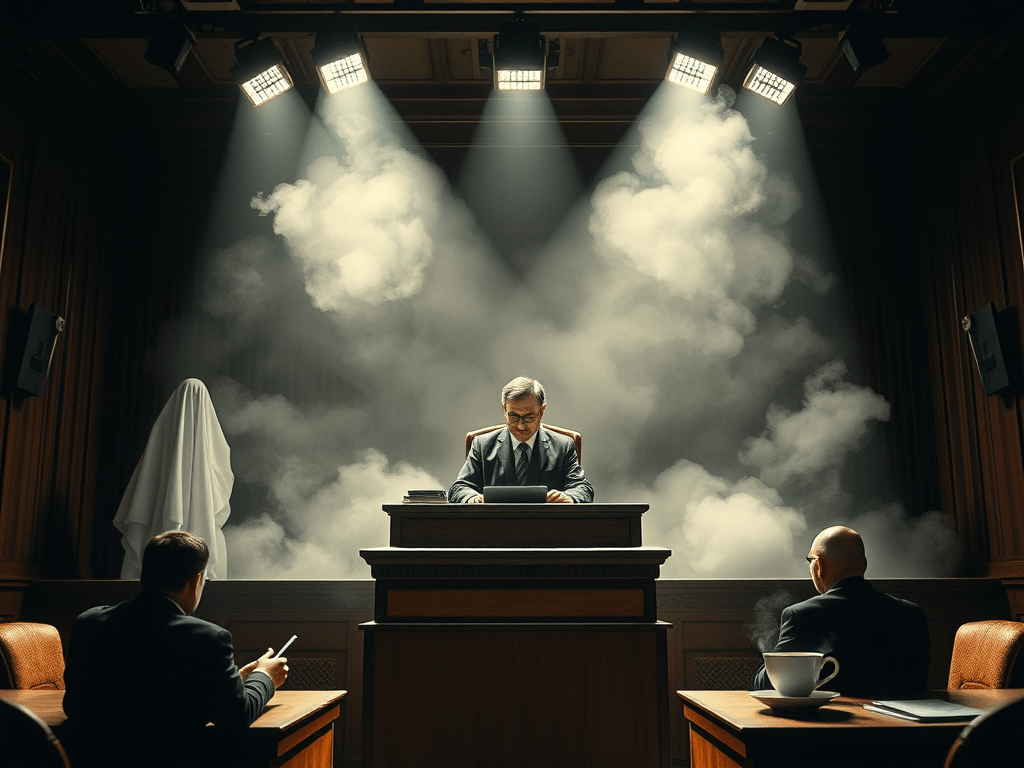
Here are five real(ish) legal cases that are so absurd, I can already see them lit in stark overhead lighting with a fog machine and a single screaming violin.
🎭 1. The Case of the Disappearing Pants
Pearson v. Chung, 2005
Working Title: “The 54-Million Dollar Pleat”
In Washington D.C., a man sued his dry cleaners for $54 million over a missing pair of pants. Yes, pants. Slacks. Trousers. The lawsuit cited emotional distress, fraud, and — I swear this is true — a violation of “satisfaction guaranteed” signage.
Why It’s Absurdist Gold:
- A courtroom becomes a cathedral of fabric-based despair.
- The pants appear and vanish like Godot.
- The plaintiff delivers monologues on lost dignity, interrupted only by a squeaky clothes hanger.
- The dry cleaners never speak — just ring a bell each time they’re accused.
- The verdict? Never delivered. Just a long fade-out on a closet.
🎭 2. The Case of the Haunted House Resale
Stambovsky v. Ackley, 1991
Working Title: “Disclosure of the Dead”
In this New York case, a man bought a house without knowing it was famously haunted. The seller had promoted it as such in local lore — even in a national magazine — but never told the buyer. He sued for rescission and won. The court literally said the house was “haunted as a matter of law.”
Why It’s Absurdist Gold:
- The ghost is a character but never seen. Every other character insists they spoke to it.
- The real estate agent is played by three actors who move in sync and speak only in disclaimers.
- Each scene begins with a door slamming, even if no one entered.
- Closing argument includes the phrase: “Your Honor, we fear what we do not disclose.”
🎭 3. The Case of the Caffeinated Catastrophe
Liebeck v. McDonald’s Restaurants, 1994
Working Title: “Hot Coffee, Cold Justice”
This one you know — the infamous “spilled coffee” case. A woman suffered third-degree burns from scalding McDonald’s coffee and sued. It became the poster child for “frivolous lawsuits,” even though the facts (and photos) were deeply serious. But the public narrative? Pure Kafka.
Why It’s Absurdist Gold:
- The coffee cup is onstage at all times. It speaks in riddles.
- A chorus of “Common Sense Jurors” sings variations of “It’s Just Coffee” — louder and louder until drowned out by medical evidence projected on a screen.
- The plaintiff testifies from a hospital gurney while lawyers debate “reasonable expectations of beverage thermodynamics.”
- In the final scene, the judge drinks the coffee and screams.
🎭 4. The Case of the Monkey Selfie
Naruto v. Slater, 2015
Working Title: “The Ape of Copyright”
A macaque monkey picked up a photographer’s camera and took a selfie. It went viral. PETA filed suit on behalf of the monkey, claiming the animal held the copyright. The Ninth Circuit held that Naruto, the monkey, couldn’t sue. But only after years of legal back-and-forth. Yes, years.
Why It’s Absurdist Gold:
- The monkey (Naruto) is portrayed by a silent, mask-wearing actor with better instincts than the humans.
- The courtroom devolves into a jungle set. Vines drop. Banana peels are evidence.
- Lawyers argue over “authorship” while being filmed live by the monkey.
- A meta-moment: the judge renders the verdict to a camera, not the audience.
🎭 5. The Case of the Unwilling Subway Performer
People v. Antoinette Shapou, Allegedly 1989
Working Title: “Stand Clear of the Closing Doors Please”
While urban legend in tone, this case is rumored to have involved a woman who sued the NYC subway for trauma after a street performer danced too close to her personal space on a crowded train. While no official record may exist, it should— and frankly, it belongs in this lineup.
Why It’s Absurdist Gold:
- The train never moves. But the sound of it screeching plays on loop.
- The plaintiff speaks only in Yelp reviews.
- The performer is a mime. The audience hates them. But they won’t leave.
- Every scene ends with the station announcement: “We apologize for the inconvenience.”
🎤 Final Argument (With Spotlight)
Absurdism isn’t just surreal for the sake of weirdness. It reflects a deeper truth: that systems meant to create order often collapse under their own weight, and the people trapped in them — plaintiffs, defendants, baristas, baboons — are just trying to make sense of the rules.
Lawyers read case law.
Playwrights write human law.
But both ask: “What does it mean to be right in a world that makes no sense?”
These cases don’t need to be rewritten to become plays.
They already are.
 Brian Brijbag