By Brian S. Brijbag, Esq.
I spend my days untangling chaos: car wrecks, medical records, conflicting narratives, and policies written in dense, joyless fonts. Litigation is, by nature, a world of structure. Of rules. Of precedence. It’s a system built to impose logic on disaster.
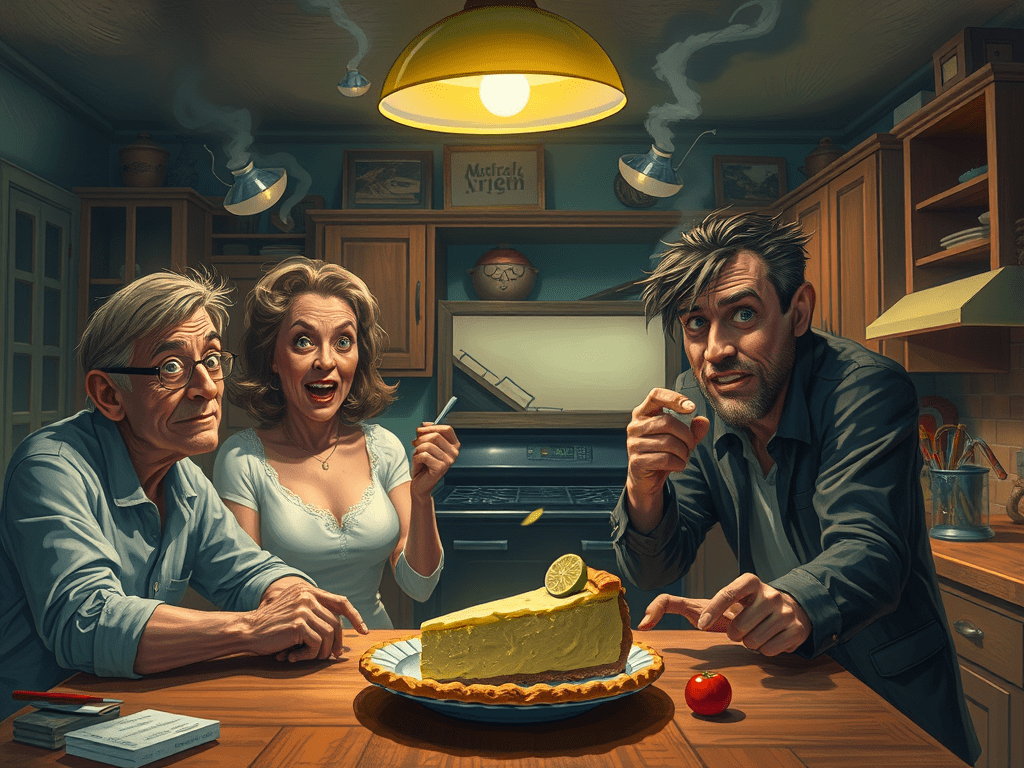
So why do I spend my nights writing plays about the last slice of key lime pie during a hurricane, or a group of mourners trying to rehearse the funeral of God?
Because structure, left unchecked, becomes absurd in itself. And absurdity, when embraced, becomes a kind of truth.
The Absurd Is Not a Joke. It’s a Mirror.
We live in a world where:
- People are denied medical care because of paperwork.
- Families must prove love in probate court.
- Juries expect plaintiffs to behave like perfect victims because they saw a TikTok once.
- Corporations offer condolences while filing motions to dismiss.
These aren’t punchlines. But they are, undeniably, absurd. The legal system often pretends to be clean, orderly, objective — but step inside any courtroom long enough and you’ll see the cracks. The human inconsistencies. The performance of it all.
Which is why absurdist theatre speaks so deeply to me. Not because it mocks, but because it exposes.
Why Pie? Why God’s Funeral?
Let’s take two examples from my own work:
“The Last Key Lime Pie”
A married couple and a wild-eyed stranger take shelter in a Florida kitchen during a hurricane. As the wind howls and power flickers, tensions rise — not over life or death, but over the final piece of pie.
It’s ridiculous. But it’s also a metaphor for marriage, for legacy, for the foolish things we cling to when everything’s collapsing. That pie is love, survival, identity — baked into citrus custard and topped with rage.
“Funeral of God”
In a black box theater posing as a funeral home, a cast of characters attempts to rehearse the funeral of a deity. No one agrees on the script. The casket keeps opening slightly. The Director loses control. One character just screams into a chair.
It’s part Beckett, part Pentecost, and completely personal. It’s about ritual, meaning, grief, and how humans fill silence with symbolism when the divine goes quiet.
Why This Isn’t That Different From Trial Work
Believe it or not, absurdism and litigation overlap more than you think.
- Both require tight structure to make sense of chaos.
- Both rely on performance — lawyers, witnesses, characters.
- Both are about people trying to find meaning in the mess.
- Both ask: “What is justice?” and often reply: “It depends who’s watching.”
In court, we argue about medical bills and pain levels, trying to quantify human experience. In theatre, we show a man screaming at a gnome and let the audience feel what words can’t say. One is transactional; the other is transformational. But both, at their best, are attempts to communicate the unexplainable.
Because Absurdism Is Honest
We live in a time of contradictions:
- Deep fakes and deeper debt.
- Algorithms that determine worth.
- Compassion wrapped in disclaimers.
Writing absurdist plays allows me to say: “Yes, this makes no sense — and neither does the world.”
But in embracing that nonsense, I also find clarity. Humor. Grace. Humanity.
Craft as Resistance
Chaos and Craft — that’s not just my website title. It’s a philosophy.
The world gives us chaos: injustice, trauma, loss, bureaucracy.
I respond with craft: stories, structure, performance, law.
But when craft becomes too rigid, too polished, too artificial — I use absurdism to break it open again.
That’s why I write plays about hurricanes and caskets and possibly cursed pies. Because somewhere in that lunacy is something real. Something honest.
And because, frankly, I’d rather scream about a funeral in a play than at a deposition.
So Why Do I Write Absurdist Plays?
Because I’m a trial lawyer who believes in meaning.
Because I’m a playwright who’s tired of pretending things make sense.
Because the world is broken — and sometimes, the only way to tell the truth
is to tell it sideways.
Now if you’ll excuse me, I need to finish a draft where two people argue about identity while stuck on a glass-bottom boat with a memory problem. You know. The usual.
 Brian Brijbag