By Brian S. Brijbag, Esq.
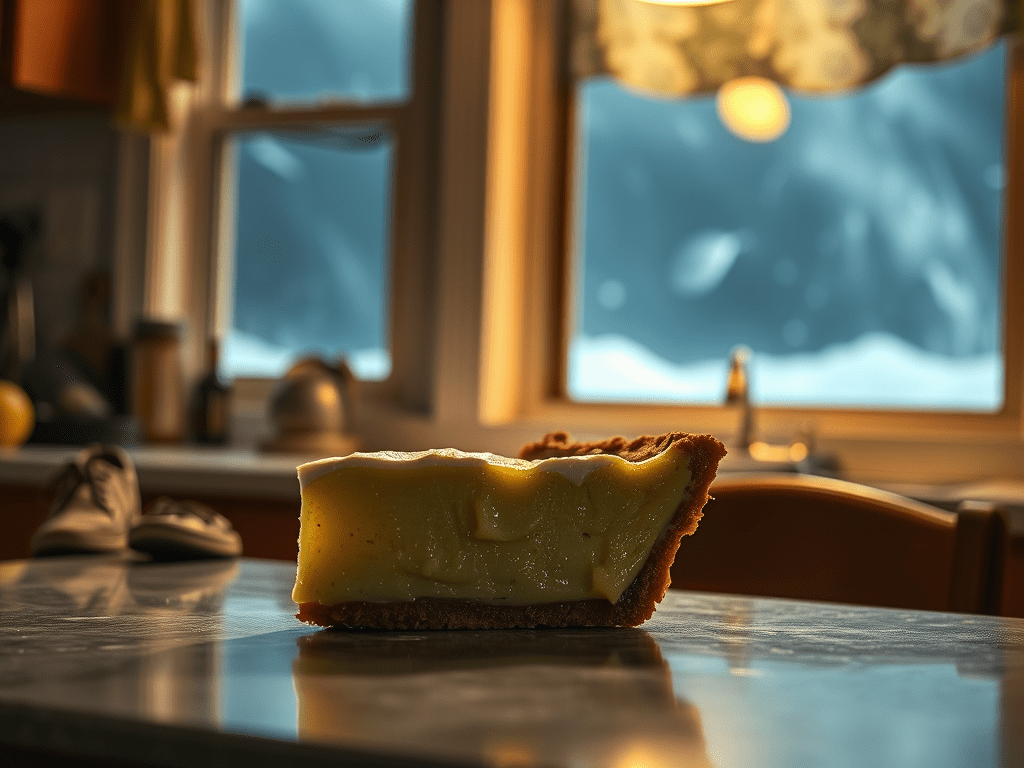
In one of my plays, a married couple is trapped in their Florida kitchen during a hurricane. Power’s flickering. A stranger named “Florida Man” has barged in. And sitting on the counter – unassuming, innocent, shimmering with citrus significance – is the last slice of key lime pie.
It’s just a slice of pie, right?
Wrong.
That slice of pie is the entire play.
Because what looks like a prop is actually a prism. The pie is memory. The pie is control. The pie is the final thread of a fraying marriage. It is dessert, yes – but also desire, denial, grief, comfort, power, nostalgia, and legacy. It’s everything they can’t say, given flavor and shape.
That’s how I write.
I don’t start with speeches about mortality. I start with a slice of pie.
The Small Thing That Stays in the Room
Every play I write begins with something small and specific. Not necessarily a “theme” or an “issue,” but a thing.
- A pair of shoes.
- A cracked chair.
- A sticky note no one removes.
- A bag of popcorn that keeps getting louder.
- A phrase that repeats until it becomes prophecy.
It’s the small object or gesture that doesn’t leave the stage. It sits there like a character. It collects meaning. It provokes tension. It reflects whatever the humans won’t say out loud.
The small thing is the vessel – the container where symbolism brews.
And the longer it sits, the more it means.
Symbolism Is Earned, Not Assigned
I don’t believe in “forcing” symbols into a script. I believe they emerge – and if you’re paying attention, you can let them grow.
When I first wrote The Last Key Lime Pie, I didn’t plan for the pie to represent the couple’s marriage. I just thought it was funny: three adults in crisis, fighting over dessert during a hurricane.
But then, as I rewrote the scenes, the symbolism took over.
- The pie was made by the wife – she’s the only one who knows the recipe.
- The husband keeps saying it’s just food, but he’s the one who guards it.
- The intruder wants it, but doesn’t understand why it matters.
- And when the pie gets dropped (as it always does), no one says a word—they just stare.
That’s when I knew: the pie wasn’t a snack. It was a stand-in for everything they’d stopped saying.
The pie had become the point.
The Audience Doesn’t Need a Legend
I don’t label these things on stage. I don’t say “THE PIE IS SYMBOLIC.” I trust the audience to feel it.
Because here’s the truth: audiences are smarter than we think. They notice repetition. They pick up on discomfort. They remember objects. They track what’s still sitting on the table after three scenes of chaos.
And if the thing is charged with meaning – if it’s been handled, avoided, stared at, argued over – it becomes louder than words.
That’s how you build symbolism without getting preachy:
You give the object time.
You give it tension.
You let it sit there – until it vibrates.
Small Things Hold Big Truths
I’ve built entire emotional arcs around:
- A shoeshiner’s box
- A spilled coffee cup
- A pair of mismatched shoes
- A duck boat safety manual
- A garden gnome that may or may not be haunted
- A stained glass window that never changes, no matter what’s said beneath it
These things aren’t just set dressing. They’re emotional load-bearers.
They’re how I turn a simple scene into something felt.
Writing with Objects, Not Explanations
If you’re a playwright, or any kind of storyteller, try this:
- Write a scene where two people talk about anything except what they’re really upset about.
- Give them something small – an object between them.
- Let the object absorb the tension.
- Don’t explain it. Don’t resolve it. Just… watch.
By the end of the scene, you’ll know what it meant.
And your audience will too.
Final Thought: The Pie Is Never Just Pie
If you’ve seen one of my plays and thought, “That’s just a pie,” or “That’s just a shoeshine,” or “That’s just a gnome”… I promise you, it’s not.
It’s the thing they can touch when the emotions are too big to name.
It’s the symbol that never raises its voice – but never leaves the room.
And if I’ve done my job right, it lingers.
Because in my work…
the smallest things carry the loudest weight.
 Brian Brijbag