(Or, why your unmarketable dream project written at 2 a.m. in a hoodie stained with Pad Thai might just be your magnum opus)
Let’s begin with a premise no marketing team wants to hear: the idea that makes your friends tilt their heads and say “…Huh” might be the thing that actually works.
I’m not talking about chaos in the metaphorical sense, like “Ooh, I’m so quirky, I put oat milk in my mac and cheese.” I mean real chaos: characters who don’t behave, plotlines that veer into metaphysical absurdity, stage directions that require both a fog machine and a defibrillator. The kind of idea you pitch with a disclaimer.
The kind of idea that makes you giggle and doubt your sanity.
That, my friends, is the good stuff. That’s craft.
Step One: Respect the Mess
Every creative field – law, theatre, baking competitive croissants on TikTok – has rules. And rules are useful. They prevent anarchy. But elegant anarchy? That’s where the art lives.
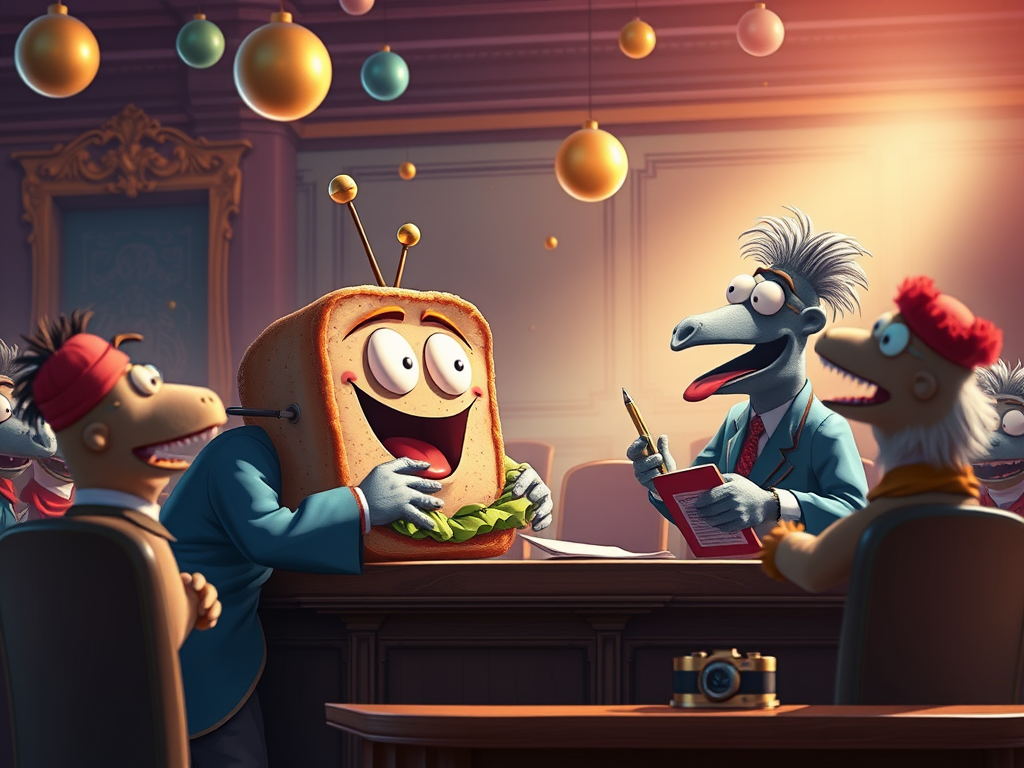
Weirdness is not a bug. It’s not a phase. It’s not something you outgrow like fingerless gloves or ironic ska bands. Weirdness is evidence of original thought unfiltered by shame. It’s the moment when you stop trying to impress and start trying to tell the truth – through a talking sandwich, a time-traveling tax auditor, or a courtroom drama where the jury is made of sock puppets.
(That last one may or may not be based on an actual staged reading I attended. The puppets were hung, ironically, for contempt.)
Step Two: Your Brain Knows Before You Do
Weird ideas are often smarter than we are. They sneak out of the subconscious, disguised as jokes. A throwaway line. A ridiculous “what if.”
“What if a Florida man tried to sue God for breach of covenant during a hurricane?”
That’s not nonsense. That’s a Pulitzer waiting to happen. Or at least a sold-out regional run and a bizarre Reddit thread.
The point is: your creative intuition is playing three-dimensional chess while your conscious brain is still checking its email. Follow the weird. It knows the way out of the maze.
Step Three: The Algorithm Hates You. That’s Fine.
Let’s be honest: we now live in a world where every idea is instantly subjected to the algorithmic crucible. “Will it go viral?” “Can it be a Reel?” “Does it feature a golden retriever holding a sign that says ‘Marriage is tax fraud’?”
But if you start crafting for virality, you end up with content, not art. Content is a sandwich. Art is what happens when someone weeps into the sandwich and names it after their childhood dog.
Don’t fear being unmarketable. Fear being boring. The market will catch up, or it won’t. But either way, you will have made something that means something. And occasionally, the world likes to be surprised.
It might even give you a Tony.
Or at least a weird award from a film festival hosted in a church basement by a man named Terry. Either way, you win.
Step Four: Commit to the Bit
Weird doesn’t work halfway. Either your characters speak only in bird metaphors or they don’t. Don’t make one of them normal just to hedge your bets.
Commitment is the soul of craft. If your idea is strange – make it elegantly strange. Style it. Structure it. Give the weirdness discipline. That’s how it moves from gimmick to genius. Chaos isn’t laziness. Chaos is the starting point. Craft is what shapes it into theatre. Or justice. Or, God help us, both.
Because what is trial law but a highly dramatized story told in front of a captive audience, where the stakes are real and the costumes are deeply underwhelming?
Final Argument
Your weirdest idea is your most honest. It’s the one uncorrupted by feedback loops, industry norms, or “what sells.” It comes from the part of you that still believes in magic, still suspects the pigeons are up to something, still thinks a courtroom can hold both tragedy and farce in the same breath.
So write the play with a ghost narrator who doesn’t know he’s dead. Pitch the show where the lead character is a metaphor for time, wearing a trench coat made of clocks. File the motion that quotes Waiting for Godot in a footnote.
Chaos is not a mistake. It is the raw material of meaning. And meaning, unlike trends, does not expire.
So go on. Be weird. Be bold. Be the pineapple in a world of apples.
The rest of us will catch up. Or we’ll sit in the front row with popcorn and thank you for the ride.

