Building Narrative Weight from Seemingly Mundane Objects
There is a particular kind of arrogance that arises during early drafts, where we playwrights believe our themes will be obvious because we’ve written them in capital letters and made two characters argue about Nietzsche in the rain.
They won’t be.
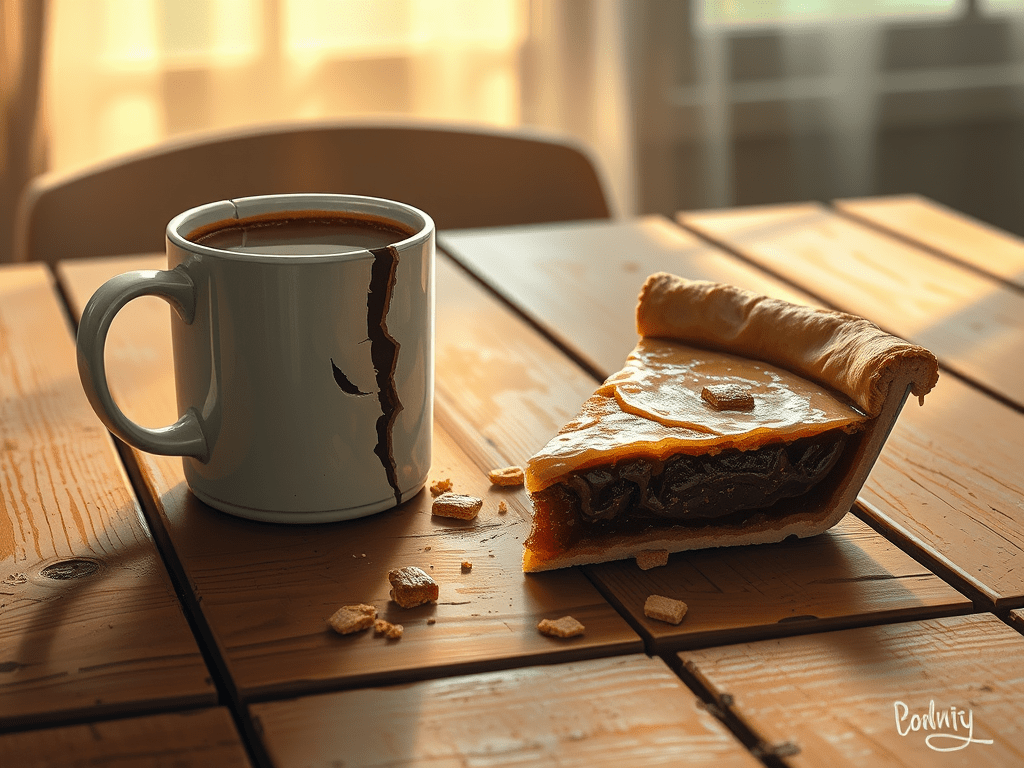
What audiences remember – what they feel – is not the speech about meaninglessness. It’s the chipped coffee mug left untouched on the table. It’s the pie with one slice missing. It’s the folding chair that no one sits in.
The objects hold the weight. The props do the talking.
The rest of us are just there to listen.
The Broken Mug: Shattered as Metaphor, But Never on the Nose
Let’s start with the mug. A staple. A humble servant of caffeine. A witness to monologues and missed cues.
But when a character picks up a cracked mug, notices the fracture, and sets it down without drinking – that is theatre. That’s grief without a eulogy. That’s divorce without the paperwork. That’s forty years of silence compressed into ceramic.
The mug speaks.
A good prop does not explain itself. It implies. It insists. It knows that symbols are not metaphors with stage directions – they are emotional shortcuts, Trojan horses for the unspeakable. The mug doesn’t say “He left.” It says “She still sets out two every morning.”
And if it breaks on stage – by accident or design – it better mean something.
Otherwise it’s just clean-up for the stage manager and a lot of noise signifying nothing.
The Slice of Pie: Desire, Division, Denial (and Dessert)
Now to pie. A symbol so deceptively cheerful it practically begs for subversion.
The last slice of pie isn’t just dessert – it’s motive. It’s power. It’s who takes, who gives, and who pretends they’re not hungry. It is the physical manifestation of longing, conflict, and what we dare or refuse to claim.
Think of it: two characters circling a pie in Act I like wolves with etiquette. A third character walks in and eats it with a shrug. That’s a plot point. That’s betrayal. That’s tragedy with whipped cream.
Or better: no one eats it. It sits there. Perfect. Untouched. A symbol of what no one will say out loud. Until it spoils. Like the marriage. Like the will they never signed. Like the apology never spoken.
Pie, used properly, is a loaded gun. And it tastes like regret.
Props as Emotional Architecture
Props aren’t decoration. They’re architecture. They hold the weight of memory, longing, avoidance, and power. They build a second script beneath the spoken one.
- The unopened envelope.
- The coat never taken off.
- The shoes placed by the door – but never worn.
These are not stage directions. They are emotional landmines.
We write characters who lie. Who deflect. Who perform. But a character cannot fake how they handle a wedding ring in their pocket. The audience may not consciously catch it – but they feel it. And theatre is a feeling-first medium.
Props offer a language beneath the language. A slow drip of narrative tension. A visual whisper.
Rules of Thumb (and Slices)
- If you use it, use it deliberately. A symbolic prop cannot be casual. If a character eats a banana, fine. If they peel a banana and don’t eat it – then congratulations, you’ve introduced Chekhov’s Banana.
- Avoid the “object as monologue trigger” cliché. The audience has seen the locket monologue. Subvert it. Make the character refuse to open the locket. Make them give it away mid-sentence.
- Let the object evolve. If the pie is just dessert in Act I and a battlefield in Act II, you’ve created something layered. If it’s still just dessert, you’re writing a cooking show.
Final Tableau
Theatre is ephemeral. Dialogue fades. Blocking is forgotten. But the image of a single coat on an empty chair, a birthday candle that won’t light, or a pie no one dares to touch – that lingers.
Because props, at their best, are memory made visible.
So choose carefully. Place intentionally. And when the props start talking?
Listen. Then let them speak for you.
 Brian Brijbag