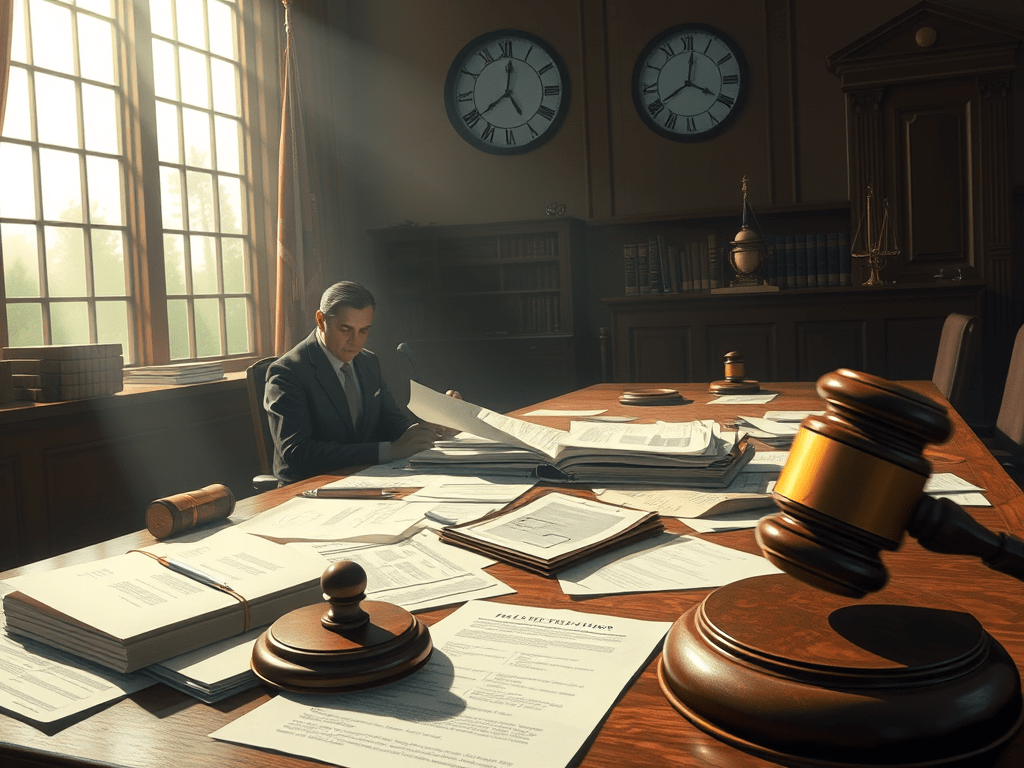
Justice gets great press.
Poets call it divine. Statues hold it blindfolded. Protesters chant for it. Superheroes allegedly fight for it, though you’ll notice none of them ever have to argue a motion to compel.
But here’s the truth that makes law students twitch and philosophers sigh:
Justice isn’t a feeling. It’s a filing deadline.
It’s 30 days to respond or forever hold your peace.
It’s a summons served on a rainy Tuesday.
It’s Rule 1.420(b).
It’s knowing which county to file in, and how many copies the clerk wants before she stares at you like you just barked in Latin.
It’s real. It’s messy. And it comes with a timestamp.
You Can’t Feel Your Way to a Verdict
People often confuse justice with catharsis.
They think it should feel good. Satisfying. Cinematic.
Cue the slow-motion walk out of court. Cue the hug on the courthouse steps. Cue the judge whispering, “You did the right thing, counselor.”
Except no judge has ever said that to me.
Usually they say, “Counsel, move on.”
Because we’re not here to feel justice. We’re here to prove it.
On paper. With exhibits. Under oath.
Justice isn’t a vibe. It’s admissible evidence.
The Law Is Not a Love Language
If you’ve ever sat with a grieving parent, a burned worker, or a client who can’t sleep because their spine clicks like a metronome since the crash …
You know they aren’t asking for a philosophical discussion on fairness.
They want help. They want something fixed. They want the world to be put back into some shape that resembles “before.”
And the only way to do that – the only way – is through the cold, sharp, and maddeningly specific instrument of law.
We take their pain and turn it into paragraphs.
We reduce trauma into torts.
We say, “Your Honor, let the record reflect what the body has endured.”
Because in court, justice only speaks one language: evidence, rules, deadlines, and the occasional footnote.
The Paper Cuts of Righteousness
It’s not glamorous.
Justice looks like paper cuts, late nights, and a printer that jams only when the judge is already on the bench.
It sounds like objection overruled and motion denied.
It smells like burnt coffee and toner ink.
But it matters.
Because someone has to care about the commas.
Someone has to notice when a clause is sneaky, or a contract is crooked.
Someone has to fight when the world shrugs and says, “That’s just how it is.”
That someone? Is a lawyer.
Preferably one with strong caffeine habits and a low tolerance for injustice in all its weasel-suited forms.
You Don’t Get Justice. You Build It.
Here’s the wild part:
Justice isn’t discovered like treasure.
It’s built.
One motion at a time. One hearing at a time. One cross-examined half-truth at a time.
And if we miss a deadline, forget to serve someone, or fail to object in the right 3-second window?
It vanishes. Gone. Forever.
Justice doesn’t wait around while we feel our feelings.
It moves on, procedurally.
Which is why it needs lawyers.
Not because we’re perfect. Not because we’re noble.
But because we’re stubborn enough to follow through.
To write it down. To file it. To make it real.
Final Argument
Justice is not a warm feeling in your chest. It’s a well-timed summary judgment.
It’s not just about what’s fair – it’s about what you can prove before the courthouse closes.
So next time someone says justice will prevail, remind them:
Only if someone remembered to calendar the deadline.
And hopefully that someone has a law degree, a good paralegal, and a worn-out pair of shoes from walking with the weight of other people’s stories – straight into court.
 Brian Brijbag