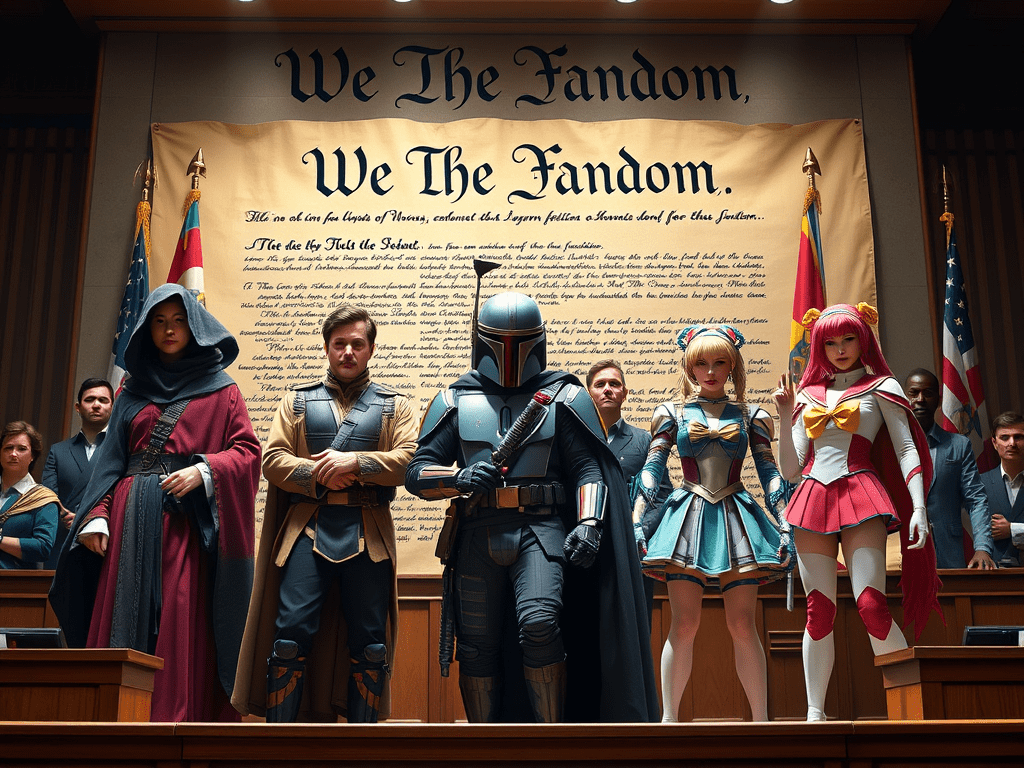
A passionate treatise in defense of cosplay, memes, and the sacred right to stan.
“If Hamilton can rap about tyranny, I can post an Obi-Wan meme in peace.”
Let us begin with a simple truth:
The First Amendment protects your right to speak, protest, and dress like a depressed Mandalorian who’s emotionally tethered to a green puppet.
This is not parody. This is patriotism.
In a world where corporations copyright your childhood and bots police your fandom, it is time – nay, past time – to draft the Fanstitution.
And in that revolutionary spirit, I present to you:
A Constitutional Defense of Fan Culture.
I. We the Fandom
We hold these truths to be self-evident:
- That all fan content is created with love, caffeine, and copyright risk.
- That cosplay is self-expression in armor and glitter glue.
- That memes are the modern pamphlets of protest, passed through the village square of Instagram stories.
- That reaction videos are the town criers of Gen Z.
- That if the government can’t stop you from burning a flag, then Disney shouldn’t smite you for selling a mashup print of Elsa and Eleven holding lightsabers.
Fandom is speech.
Fandom is parody.
Fandom is political.
Do not let the mouse ears fool you. This is revolution in rhinestones.
II. Cosplay Is Protest with Better Eyeliner
The Founders wore powdered wigs and tights. Cosplayers do the same, with more commitment and better contour.
To wear the robes of a Jedi is to declare war on conformity.
To sew your own Sailor Jupiter skirt is to reclaim identity, body, and story.
To build a 3D-printed Iron Man suit in your garage while arguing about whether Tony Stark violated the Sokovia Accords is – objectively – the highest form of civic engagement.
You are not just dressed up. You are speaking.
In a world where dress codes can be enforced, gender can be policed, and identity is commercialized, every stitch of cosplay is defiance.
It is art, yes. But it is also argument.
So when they tell you to “keep it unofficial,” you tell them you’re protected under fashion-based expressive conduct – and then cite Tinker v. Des Moines while adjusting your foam shoulder pads.
III. Memes Are Satire with JPEG Compression
Ben Franklin published cartoons of snakes to unite the colonies. You post the “Anakin crying on Mustafar” meme to explain how your ex took your Taylor Swift vinyl in the breakup.
Same energy.
A meme is not just a joke. It is a cultural shorthand, a shared reference, a micro-rebellion in the language of fandom. And while copyright law may not like that, the Constitution tolerates it.
Parody is protected.
Satire is sacred.
Humor is political oxygen.
So yes, you can put Judge Judy next to Kylo Ren and add “me arguing with my moral compass” as a caption. That’s not infringement. That’s commentary – and honestly, it’s more transformative than most Netflix reboots.
And let’s be clear: when the powers that be control the stories, the meme becomes the counterspell.
IV. Fandom as Assembly, TikTok as Town Hall
The right “peaceably to assemble” doesn’t end at the steps of Congress. It exists in convention centers, Discord servers, and panels where 400 people scream when a PowerPoint says “Ship Discourse: Legally Binding.”
You are not just a fan. You are a participant in the democratic project of culture.
- Artist Alley is the local artisan market of nerddom.
- Fanfic archives are the revolutionary press.
- Twitch chats are digital salons of absurdist enlightenment.
- TikTok edits? Political theater in 30-second doses.
When you duet a trailer with a raised eyebrow and dramatic lighting, you are engaging in civic remix. That’s speech. That’s transformation. That’s your constitutional right to thirst-post responsibly.
V. A Warning About the Empire (Yes, That One)
All this said, let us not be naïve.
Your rights exist in tension with corporate might.
The government may not suppress your mashup of Frodo and SpongeBob, but a DMCA bot sure will.
This is not tyranny in the 18th-century sense.
This is automated feudalism.
A copyright strike is the new redcoat.
A takedown notice is the new tea tax.
And if you’re going to throw anything into the harbor, let it be the idea that creativity belongs only to those with IP lawyers.
VI. The Closing Argument (Now with More Capes)
You don’t need a law degree to be a legal revolutionary.
You just need a hot glue gun, a clever caption, and the willingness to stand in the gap between what is protected and what should be.
Because every meme you make, every reel you post, every fandom deep-dive you lovingly upload at 2 a.m.,
is a declaration.
That culture is for the people.
That creativity can’t be owned by a filing cabinet.
That speech wears many outfits – and some of them have horns and a Loki variant badge.
✒️ Postscript from the Court of Chaos and Craft
If cosplay is your protest and memes are your manifesto, I am your court-appointed counsel in a cape.
And I’ll say this until I’m pixelated and banned:
Fandom is not just fun.
It is free speech in a lightsaber sheath.
So go. Remix boldly. Post with purpose. And if they come for your parody…
you tell them Hamilton rapped first.
🖖
—Legally Yours, in Glitter and Good Faith
Brian S. Brijbag, Esq.
 Brian Brijbag