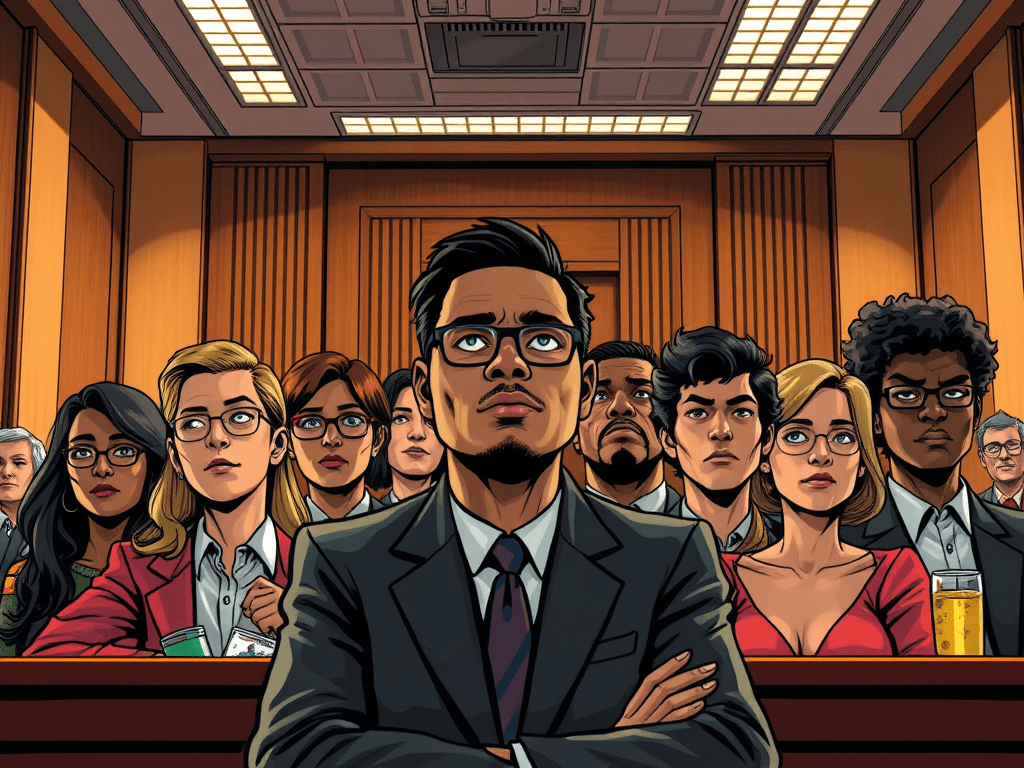
You bring your biases, I’ll bring mine, and maybe – just maybe – we’ll make a verdict.
Jury duty is the last place in America where people from every conceivable corner of the human condition are forced into a single, climate-controlled room with fluorescent lighting and the vague promise of justice. It’s not just a legal process – it’s a potluck of humanity, except no one brought anything they actually wanted to share.
You don’t RSVP to jury duty. You get summoned like a reluctant wizard to a quest you didn’t sign up for. The “invitation” arrives in a government envelope that has the warmth and charm of a parking ticket, cheerfully reminding you that failure to attend may result in fines or imprisonment. Which, in its own way, is a kind of RSVP.
The day begins in the assembly room, which sounds noble but is really a DMV with aspirations. A TV in the corner loops the orientation video – part civic pride, part hostage tape – while a bailiff wanders by to make sure no one has gone feral yet. Strangers sit together, side-eyeing one another like it’s a high school cafeteria, instantly forming silent judgments:
- “That guy’s going to get dismissed for cause within ten minutes.”
- “She looks like she keeps a dream journal and might vote guilty if Mercury is retrograde.”
- “Please, dear God, don’t let me be in a panel with the guy in the ‘Taxation is Theft’ T-shirt.”
And here’s the truth no civics textbook admits: jury selection is less about finding “impartial citizens” and more about seeing if your crazy and my crazy cancel each other out. The prosecution wants the juror who trusts authority. The defense wants the juror who hasn’t trusted authority since a mall Santa let them down in ’92. And the judge just wants twelve people who can make it to lunch without being held in contempt.
When you finally make it to voir dire – the legal term for “awkward icebreaker where you confess your feelings about the police in front of fifty strangers” – you start to realize the delicious absurdity of it all. Here we are, twelve (or six) alleged equals, each hauling our own casserole dish of bias to the table:
- Grandma’s “I raised three cops” casserole.
- The guy with “True Crime Podcast” tattooed on his bicep bringing his paranoia pie.
- Me, showing up with a skeptical soufflé that collapses under cross-examination.
The bailiff swears us in, and suddenly we’re a unit – a mismatched patchwork of strangers now trusted to weigh evidence, assess credibility, and pretend we didn’t just zone out during that one expert witness who spoke exclusively in acronyms.
Mock Trial Transcript: Deliberation Room, Act I
Foreperson: Okay, people, let’s remember – this is a murder trial, not an improv class.
Juror #6: You say that like they’re mutually exclusive.
Juror #4: Can we just talk about how the defendant kept calling the knife “my emotional support cutlery”?
Juror #8: I’m still hung up on Exhibit B. Who alphabetizes their spice rack and owns three machetes?
Juror #2: (flipping through notes) Listen, all I’m saying is, the eyewitness testimony was shaky. I wouldn’t trust her to describe a potato, let alone a suspect.
Juror #10: That’s because she was literally describing a potato. It was Idaho Day at the farmer’s market.
Juror #7: We need to focus. Does anyone here believe the alibi?
Juror #9: Absolutely not. Nobody goes to the zoo “just to think” for six hours.
Juror #3: Speak for yourself. The otters are my therapists.
Foreperson: All right, let’s take a preliminary vote. Show of hands – guilty?
(Half the hands go up, the other half hold coffee cups like shields.)
Juror #5: Before we decide anything, can we all agree that the defense attorney’s tie was working against him?
Juror #12: Oh, 100%. You can’t argue innocence while wearing a tie that screams “novelty gift from my aunt in Branson.”
Juror #6: Can we put that in the official verdict? “Guilty, and the tie didn’t help.”
And when deliberations drag on, it’s no longer a courtroom – it’s Thanksgiving dinner at a dysfunctional relative’s house. We try to be polite at first. We reference the evidence. We pass the testimony around like a bowl of mashed potatoes. But eventually, someone slams down the proverbial gravy boat and says what we’re all thinking: “That witness was full of it.”
If we’re lucky, we reach consensus – an imperfect, wobbly, human-made verdict. If we’re not, it’s a hung jury, the judicial equivalent of everyone taking their casserole home untouched.
Jury duty is America in miniature: flawed, messy, and miraculous when it works. Twelve strangers, each with their own recipe for truth, trying to feed justice without poisoning it. You can call it a burden if you want, but I call it the last time the country actually asks all of us to show up with something to share.
Because when the chips are down – and the chips are usually stale – you bring your biases, I’ll bring mine, and maybe – just maybe – we’ll make a verdict.
 Brian Brijbag