(How to Lose Yourself Just Enough to Find the Truth)
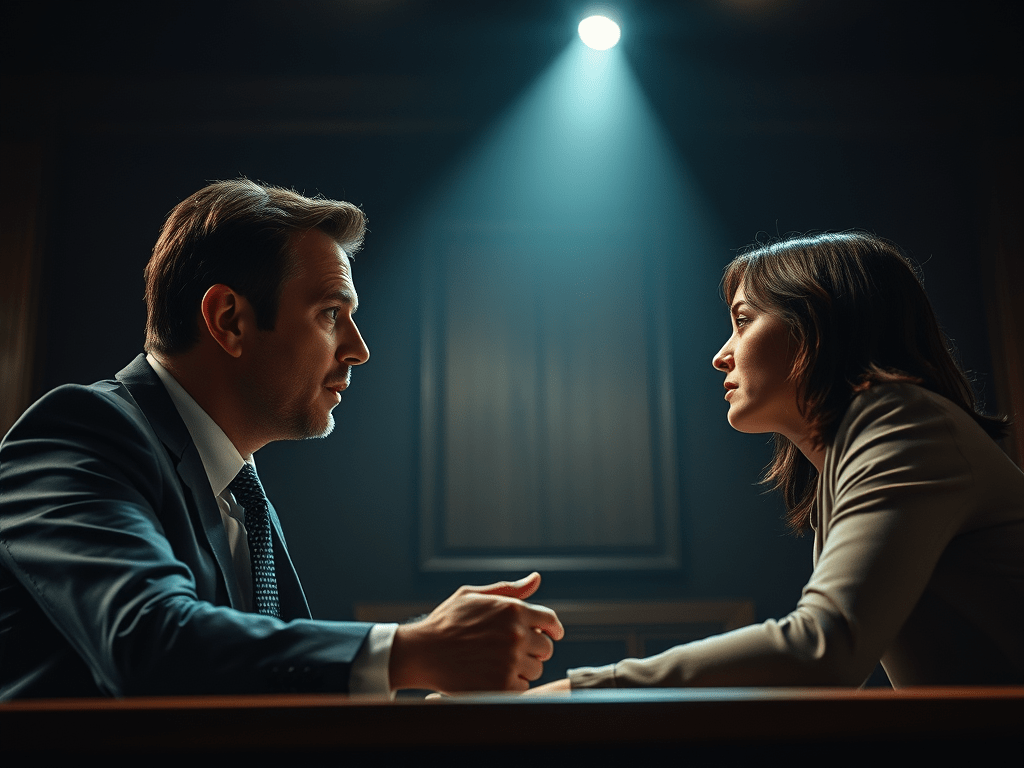
The courtroom is a stage that denies it’s a stage.
The script insists it’s nonfiction.
The actors swear under oath.
But make no mistake: the trial is theatre – sacred, structured, and dangerous. The bailiff calls “All rise,” and we do, obediently, as though waiting for the curtain to lift. The bailiff is our stage manager. The stenographer, our playwright. The gallery, our reluctant audience. The stakes are not applause, but freedom, money, and the ghostly concept of justice, that ancient understudy who never quite remembers her lines.
And we – the attorneys – are the method actors of this strange ritual.
I. THE CHARACTER
When you take a case, you take a role. You learn your client’s rhythms, their small tics of fear and frustration. You memorize their story the way an actor memorizes lines that must sound improvised. You study their silences. You learn what they don’t say – because what they withhold will be Exhibit A of the soul.
To represent them well, you must live in the gravitational field of their suffering. But here’s the paradox: empathy is oxygen; identification is quicksand. The method actor warns us of this – never lose the “I” in the “them.”
And yet, you will. At least a little.
The best performances – the best advocacy – come from the brief, trembling moment when you forget which part of the pain was yours to begin with.
There’s no manual for this. No professional rule of conduct warns you about crying in your car after trial.
II. EMOTIONAL MEMORY IN EXHIBIT FORM
Stanislavski called it affective memory – the mining of past emotion to ignite present truth. Lawyers do this too, though we hide it behind terms like “client narrative” and “jury persuasion.”
You will remember your own griefs to argue another’s loss. You will summon your own guilt to understand your client’s fear. You will reach inside your archive of heartbreak to find the right tone for “Ladies and gentlemen of the jury.”
And yet, you can’t show it. Theatre rewards transparency; law rewards restraint. The method for us is internal combustion – the invisible fire that fuels persuasion without ever burning the robe.
That’s the craft.
That’s the madness.
III. THE SCENE PARTNER
Actors have scene partners. Lawyers have clients.
But in law, your scene partner is always in crisis.
You must read their eyes the way Hamlet reads his ghosts – unsure if they are leading you toward redemption or ruin.
Some clients are Shakespearean: all tragedy and thunder. Others are Beckett: absurd, half-laughing through the apocalypse. You must adjust your tone accordingly. For one, you are the hero. For another, the priest. For a few, the audience member who stayed until the end because someone had to.
The trick is to mirror without mimicking, to reflect their truth without wearing their trauma like a borrowed costume.
IV. OBJECTIVES AND OBSTACLES
Every scene has a goal. Every case, a heartbeat.
An actor asks: What do I want?
A lawyer asks: What does my client need me to want for them?
The obstacle? Everything. The rules of evidence. The slow erosion of faith. The judge’s eyebrow. The opposing counsel’s smile that says they’ve found the document you swore didn’t exist. The jury’s fatigue at the word “negligence.”
Still, we persist – adjusting tactics mid-scene, rewriting arguments in real time, dancing with logic until it stops fighting back.
The method lawyer, like the method actor, knows that truth is never a fixed line. It’s a pulse that moves depending on who’s holding the spotlight.
V. REHEARSAL
No actor walks onstage unrehearsed.
No attorney should walk into court unscarred by preparation.
We pace like restless thespians, practicing cross-examinations into bathroom mirrors, mouthing opening statements in the car, marking up case law like stage directions: pause here for moral weight, raise eyebrow at exhibit C.
Preparation becomes its own religion. You rehearse not for perfection but for surrender – to become so fluent in the story that it moves through you like music.
When you finally stand before the jury, you aren’t reading lines anymore. You’re living them. That’s when the art becomes dangerous. That’s when you feel the electricity of belief.
VI. THE CURTAIN CALL NOBODY CLAPS FOR
Actors take bows. Lawyers take verdicts.
One gets roses, the other gets migraines.
But both must face the same haunting question: when the lights dim, who are you now?
The method actor leaves traces of their character in the dressing room mirror. The lawyer leaves fragments of cases in the soul – the client who lied, the one who didn’t, the one who called you “the only one who listened.”
It changes you. Every performance does. Every argument rearranges something small and sacred in your chest.
That’s why you must learn the sacred art of detachment: closing the file, not just the case. Hanging up the costume. Stepping back into the self that belongs to your family, your faith, your Friday evenings.
Because if you don’t, you’ll become what the old actors call a “ghost light” – a lonely bulb left burning after the show ends, keeping the darkness company.
VII. THE FINAL SCENE
So yes, maybe we are all actors in wigs of jurisprudence. Maybe justice itself is the greatest improv show on Earth – half philosophy, half farce, held together by the desperate hope that someone, somewhere, will believe the story we’re telling.
But when it’s done right, when method meets mastery, when empathy meets eloquence – something holy happens. The courtroom breathes. The law remembers its humanity.
And you – the method attorney – stand at the center of it, neither saint nor showman, simply present.
Present enough to feel.
Present enough to argue.
Present enough to know when to stop performing and start being.
Epilogue
The greatest method actors never disappear into their roles; they transform the audience by inhabiting truth. The greatest lawyers do the same.
Because the law, like theatre, isn’t about pretending. It’s about revelation – the fragile moment when artifice collapses and the truth walks naked across the stage, unashamed.
And the audience, for once, believes.
 Brian Brijbag