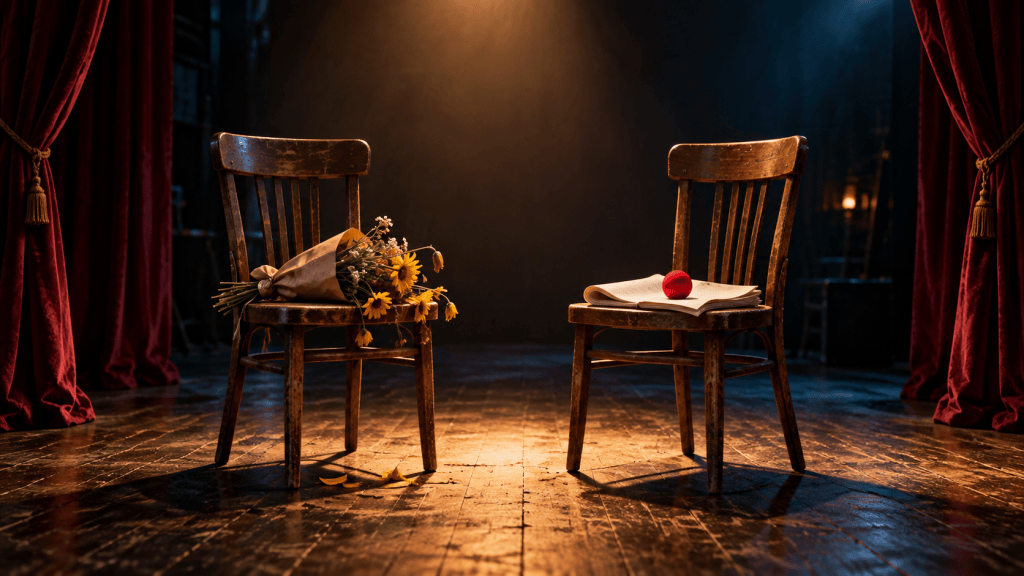
Someone has died, and the family is arguing about whether the reception needs a second cheese tray. The argument becomes vicious. A cousin says the deceased hated cheddar. Someone else says he ate it every Christmas. For six minutes, everyone has a position on cheese because nobody can bear to discuss the empty chair.
That is useful territory for dark comedy. The food matters terribly to these people, and we understand why they need it to matter.
Learning how to write dark comedy means paying attention to what people do when ordinary conversation becomes impossible. A character may joke, make a ridiculous demand, or start an argument that has almost nothing to do with the apparent subject. The laugh comes from recognizing the behavior. The hurt comes from recognizing the reason.
For playwrights and fiction writers, the work begins with taking that reason seriously.
What makes dark comedy work
Dark comedy finds humor in subjects that carry real fear or pain: death, grief, cruelty, failure, the institutions we depend on. The term describes a broad range of work. Here, I am interested in stories where the audience can laugh and still care about the person having a terrible afternoon.
A grim subject alone gives you very little. Put a coffin onstage and you have furniture with implications. You still need somebody who wants something, somebody making that difficult, and a reason the encounter cannot simply end.
The useful question is specific: What does this person need so badly that they are willing to look ridiculous trying to get it?
Give the character something concrete to fight for
“She is grieving” describes a condition. It does not tell an actor what to do.
“She needs her brother to stop throwing away their father’s shoes” gives her an action. She can block a doorway, hide a shoe, bargain, lie, or insist the shoes belong to somebody else. Now her grief has entered the room through behavior. Her brother has something to resist.
This is where writing dark comedy gets interesting. The practical dispute can be very small while the meaning beneath it is enormous. A pair of shoes becomes the last available evidence of how a man stood in the kitchen.
Give both characters credible needs. The brother may have spent three days clearing the house alone. He is exhausted. The charity van is coming at four. He also loved their father. His desire to finish the job deserves as much attention as her desire to stop it.
An audience has more to do when both people make sense.
Find the pressure inside the absurd premise
In my play A Straight Line Is Just a Circle That Gave Up, a mother puts her late son’s favorite cartoon frog on his headstone. A company representative arrives to object. The premise brings corporate procedure into a place where a mother is trying to remember her child.
The premiere announcement on BroadwayWorld introduces that collision. For the writing, what matters is how long each person can keep treating the encounter as the kind of problem they understand.
A useful absurd premise creates a practical conflict you can keep working. The mother wants to preserve something. The representative has a task. Every attempt to complete that task meets a human fact it cannot comfortably accommodate.
Try this with your own scene. Write down the rule one character is enforcing. Then write down the specific thing another character will lose if that rule is followed. If the loss is vague, keep looking.
Know who pays for the joke
Before keeping a dark joke, look at the person who has to absorb it. What does the laugh ask the audience to believe about them?
Imagine a receptionist handing a bereaved person a satisfaction survey. You could write the scene so the bereaved person seems foolish for becoming upset. You could also let us see the receptionist carefully explaining which box to tick if the deceased cannot provide feedback. The same situation produces a different relationship with the audience depending on where you put your attention.
Cruelty may belong in the scene. Characters can say appalling things. But a writer should know whose understanding the scene deepens and whose suffering it has made convenient.
Specificity helps. Give the receptionist a reason to insist on the form. Perhaps unanswered surveys count against her. Now the institution has recruited two people to make each other miserable, and neither has enough authority to end the conversation.
Let the dialogue reveal what people are avoiding
A character who can explain every feeling beautifully may be useful at a retreat. Put that person in every scene and your play will last nine minutes.
People often explain something adjacent to the truth. A daughter knows the exact price of her father’s shoes. Her brother remembers the size. Neither says what the shoes mean until the argument forces them somewhere they meant to avoid.
Consider this invented exchange:
“He never wore those.”
“The soles are worn through.”
“I mean out. He never wore them out.”
There is a small retreat inside that correction. Let the actor have it. Resist adding a sentence that explains the daughter’s fear of forgetting. The shoes and the correction have already given us something to notice.
When revising dialogue, look for the line where a character becomes unusually precise. Ask what that precision is protecting.
Allow a laugh to have consequences
A joke can change a scene. Someone laughs who should not. Someone recognizes an old family phrase. A character realizes the other person has been listening more closely than expected.
That change deserves time. If every exposed feeling is immediately covered by another punchline, the audience may stop trusting that anything can reach these people.
In a staged reading, listen to what happens after the laugh. Can the actors continue pursuing what they want? Does the next line gain anything from the laughter, or is it merely waiting its turn?
Silence is useful when something has happened that the characters cannot easily answer. Give it a cause. An actor trying to decide whether to return a shoe has more to play than an actor instructed to pause meaningfully.
Revise for the behavior beneath the clever line
Dark comedy invites a particular writing problem: everybody sounds delighted to have been written by you. The grieving daughter, the charity driver, and the man delivering sandwiches all arrive with polished observations about mortality.
Read each role aloud on its own. Notice vocabulary, sentence length, and the kind of information that person offers under pressure. One character might count things. Another changes the subject. A third offers help so persistently that nobody can admit they do not want it.
Then remove the line you are proudest of and read the scene again. Sometimes you will put it back. Sometimes you will discover that it has been holding the door open while the scene was trying to leave.
The revision I trust most is simple: after each exchange, ask what changed. Someone gained time, lost patience, revealed knowledge, or made a choice harder to reverse. A scene needs that movement even when its characters are determined to remain exactly where they are.
Keep the ending honest
The brother can miss the charity van. The daughter can keep one pair of shoes. They can still be angry when they lock the house.
That may be enough. Their father remains dead. The house still has to be cleared. But one person has made room for something the other could not explain at the beginning.
This is the territory I keep returning to in my plays and the creative practice I call Elegant Anarchy. I want to see what people manage to do for one another while their explanations are failing.
Write the scene until somebody does something that costs them a little. Then see whether you need the speech.
The shoes can probably speak for themselves.

