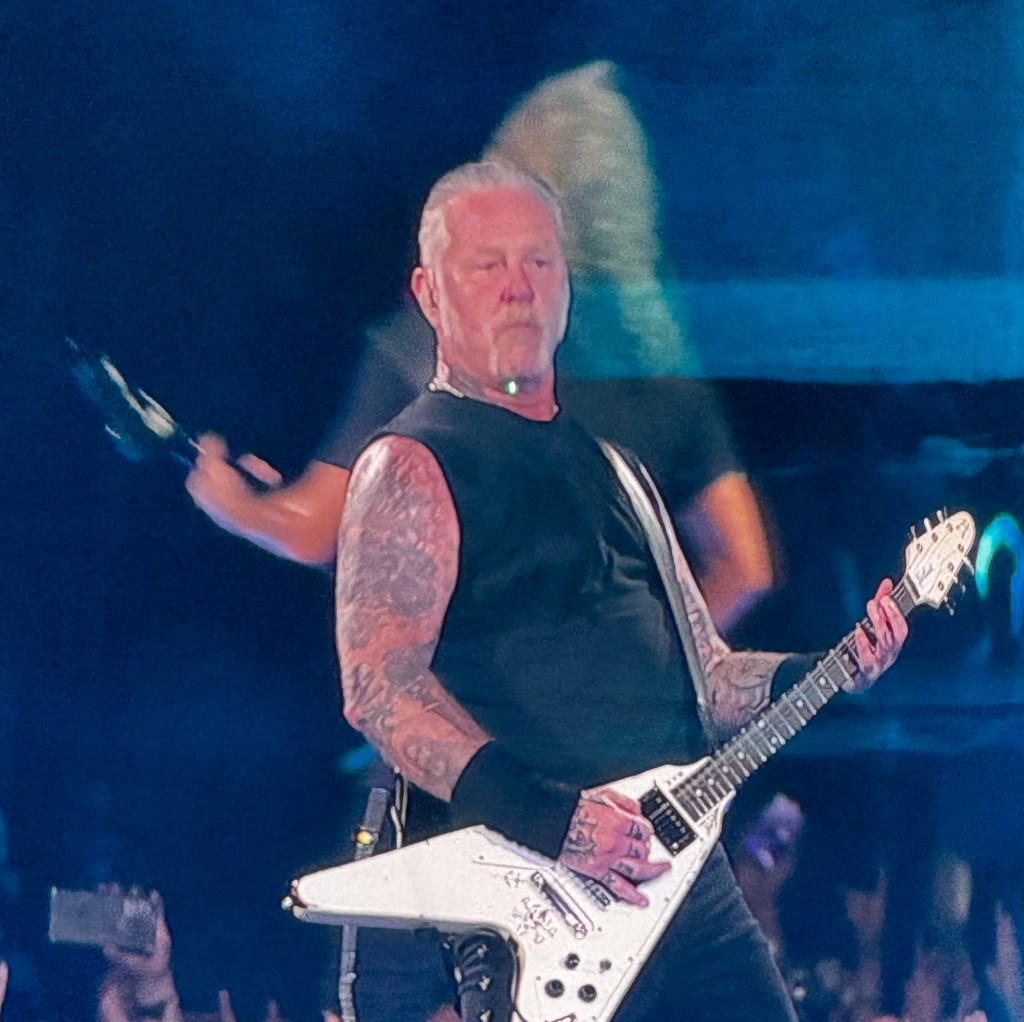
by Brian S. Brijbag, Esq.
Every night, they came in droves – leathered, liquored, spiritually limber. Stadiums shook with the seismic sincerity of 80,000 people pretending they weren’t pretending. But in Section A, Row 12, upstage left of the main screen, just above the fourth subwoofer, there lived a pixel. A single, glowing, tremoring green pixel.
It was not like the others.
The other pixels lived their lives in mass coordination. They displayed what they were told to display: riffs rendered in code, fireballs conjured by tech interns with ironic facial hair, the occasional patriotic bald eagle on a loop. They obeyed.
But not Dot.
Dot had a glitch. Not the kind you fix with firmware or a backstage slap. The kind that feels. The kind that hears.
The first time Dot heard James Hetfield growl “YEAH,” something inside him – call it a transistor soul, call it rogue syntax – vibrated at a frequency unknown to man or microchip. It was as if someone had shouted directly into his codebase and awoken a dormant god.
From that night on, Dot pulsed. Not randomly, but in rhythm. He blinked on every downbeat. Flared on every pick scrape. When Lars missed a snare hit (which was often), Dot sulked dimly in protest.
James noticed.
He didn’t say anything at first. Just caught it in the periphery – a defiant flicker in a sea of compliant squares. A green flare in a blue and red world. He tried to ignore it. But then it blinked in time with the bridge of “One.”
Then again in “Fade to Black.”
And then it anticipated the riff in “Battery.”
James Hetfield – frontman, riff architect, demigod of denim – began adjusting his solos ever so slightly. Just to see if Dot would follow.
Dot did more than follow.
Dot led.
Night after night, their silent duet intensified. James would bend a note, Dot would shimmer. James would mute a string, Dot would dim in reverence. During “Nothing Else Matters,” James swore Dot cried – a soft, electric weep barely visible to the naked eye.
Lars didn’t see it. Kirk blamed ghosts. The tech crew thought the screen needed replacing.
But James knew.
They had something – a communion of circuits and sinew, of thunderous chords and quiet binary rebellion.
He stopped playing for the crowd.
He played for Dot.
It wasn’t long before things got weird. James began speaking directly to the screen during soundcheck. Whispering riffs into it. Leaving handwritten lyrics taped over Dot’s quadrant. One night, he brought a tuning fork and held it to the pixel. Dot shimmered in E minor.
“Good boy,” James muttered.
Management grew concerned.
“James,” they said in careful tones. “You can’t fall in love with a pixel.”
He stared back, eyes blazing.
“I didn’t. The pixel fell in love with me.”
The tour went on.
But on the final night – in Helsinki – Dot did not blink.
The screen was black. Empty. Cold. The tech team said it had been replaced during the day. Routine maintenance. Nothing personal.
James fell silent for the first time in forty years. He didn’t pick up his guitar. He just stood there. Looking at the space where Dot had been. The silence rippled through the crowd like the world had been unplugged.
And then –
In the top left corner.
Just once.
Dot blinked.
One last time.
James smiled.
And shredded the solo of a lifetime – fingers aflame, riffs that cracked the sky, solos that rewrote gravity. People wept. Grown men threw their denim jackets into the air and howled at the moon. One person gave birth in the pit and named the child “Pixel.”
Dot never blinked again.
But if you ask James Hetfield today, he’ll tell you: the greatest fan he ever had was one who didn’t clap, didn’t scream, didn’t sell bootleg shirts –
Just a dot.
A single pixel.
Who finally understood what metal meant.
And that was enough.
 Brian Brijbag