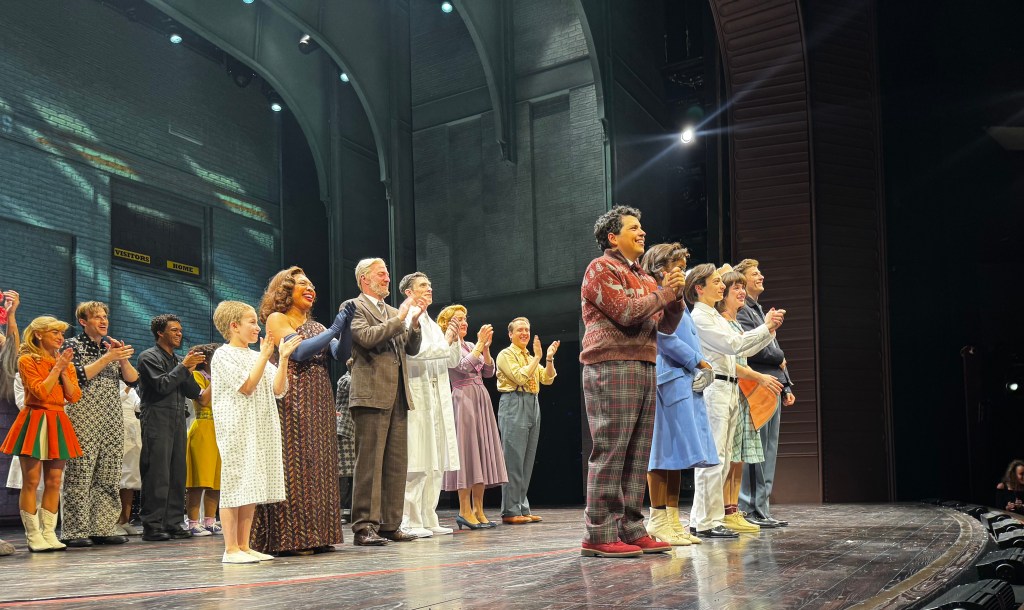
There is always a quiet question hanging over stage adaptations of major screen properties. Not whether they will sell, but whether they will justify their existence as theatre. Stranger Things: The First Shadow answers that question with surprising confidence. This is not a decorative extension of a brand. It is a production that understands the grammar of the stage and, at its best, speaks it fluently.
What distinguishes the evening immediately is its technical command. The stagecraft is not simply polished. It is often breathtaking. Effects are deployed with precision and restraint, allowing illusion to feel like storytelling rather than interruption. The production trusts the audience to meet it halfway, and in doing so achieves something rare in large-scale commercial theatre. It creates moments that feel genuinely uncanny. Not because they are loud, but because they are exact.
The acting matches that ambition. This is a uniformly strong cast delivering performances that resist the easy pull of imitation. No one is coasting on audience familiarity. Instead, the actors ground the piece in emotional clarity, allowing the mythology to emerge from character rather than overwhelm it. There is real discipline here. Stakes are played cleanly. Relationships are legible. The result is a show that feels inhabited rather than constructed.
For those familiar with the Netflix series, the production offers a dense layer of rewards. The Easter eggs are thoughtfully embedded and rarely feel gratuitous. They deepen the narrative without turning it into a checklist of references. More importantly, the script treats its prequel status with a degree of seriousness that is often missing from this kind of material. It is less interested in explaining lore than in exploring the emotional conditions that make that lore inevitable. There is a sense of slow formation, of damage taking shape over time. That focus gives the piece weight.
At its strongest, the production leans into theatrical inevitability. We are watching not what happens, but how it becomes unavoidable. That distinction matters. It allows tension to build even when outcomes feel predetermined. The show understands that tragedy onstage is not about surprise. It is about recognition.
None of this, however, excuses the significant issues that affected the performance I attended. The front-of-house experience was unexpectedly poor for a production of this profile. House doors opened only fifteen minutes before showtime, creating a compressed and slightly chaotic entry. Staff interactions lacked warmth and efficiency. It is a small detail in theory, but in practice it sets the tone for the entire evening, and here that tone felt undercut before the show even began.
More troubling were the sound problems. They were persistent enough to disrupt immersion throughout the performance. In a production that relies heavily on sonic atmosphere, this is not a minor flaw. It is structural. The issue culminated in a complete loss of sound for the final fifteen minutes. That is a serious failure, particularly in the closing stretch of a show that depends on cumulative tension and sensory cohesion.
And yet, what is striking is how much of the production survives even under those conditions. The visual storytelling remains potent. The performances continue to carry emotional clarity. The staging holds its shape. In an unintended way, the technical failure reveals the underlying strength of the piece. Strip away one of its major design elements and it still functions.
That resilience points to the central achievement of The First Shadow. Beneath the scale, beneath the brand, beneath the effects, there is a production built with real theatrical intelligence. It understands pacing. It understands image. It understands how to let silence and stillness do work when spectacle falls away.
This is not a flawless evening. The operational missteps and sound failures are too significant to ignore. But they exist around a production that is, in its conception and execution, far more thoughtful and accomplished than one might expect from a franchise expansion.
Stranger Things: The First Shadow is not simply a companion piece to a popular series. It is a reminder that even the most familiar worlds can feel newly alive when translated with care, discipline, and a genuine respect for the stage.
 Brian Brijbag