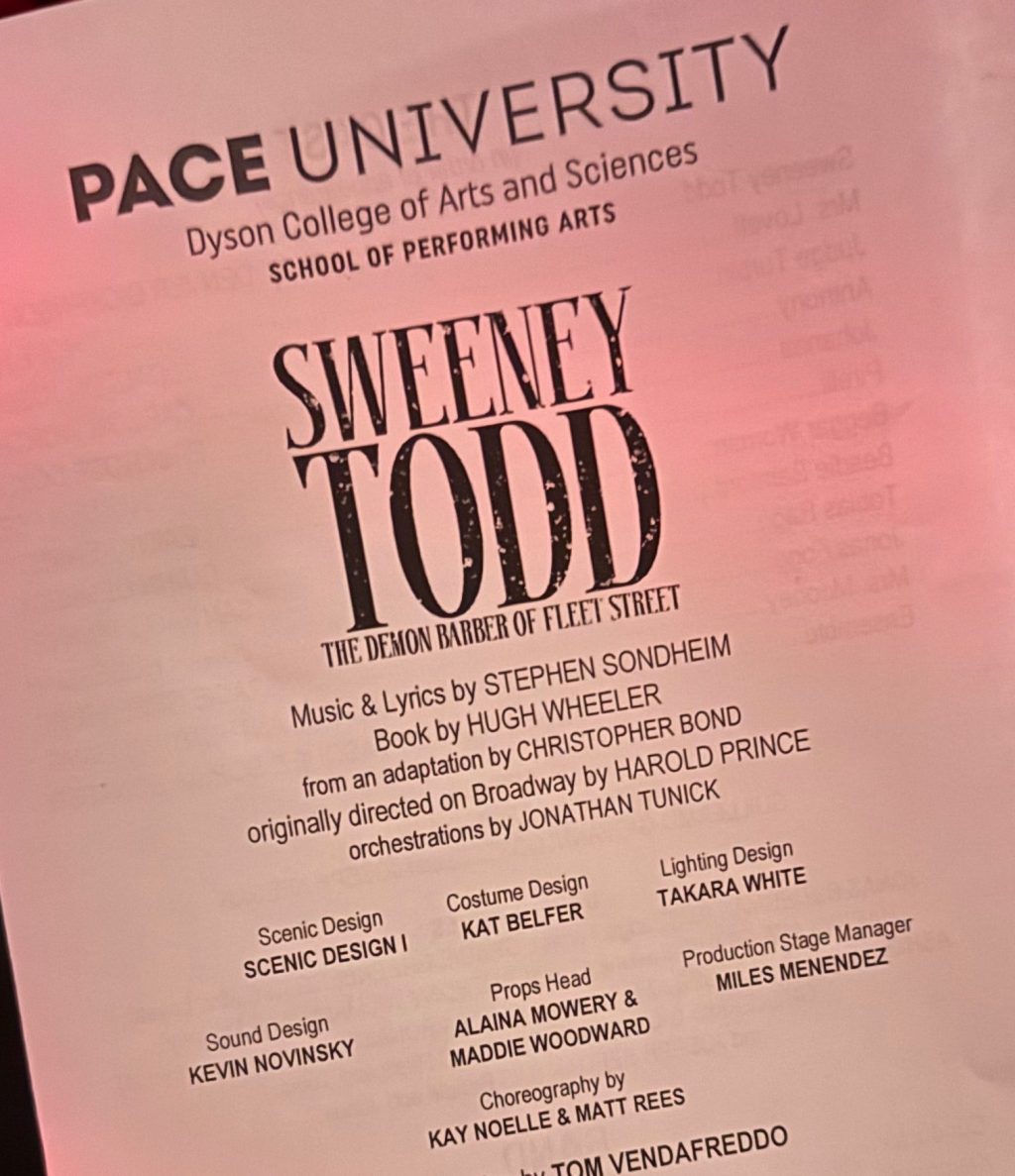
There is a particular electricity to a closing performance, a sense that the work has settled into itself and is now ready to take a final, confident breath. That was unmistakably present on April 18 at Pace University’s Sands College of the Performing Arts, where Sweeney Todd: The Demon Barber of Fleet Street concluded its run with a production that felt not like a student exercise, but a fully realized piece of musical theatre.
Directed by L. Morgan Lee with music direction by Tom Vendafreddo, the production understood something essential about Sondheim’s masterpiece: precision is not the enemy of passion, it is its vessel. The score was handled with admirable clarity and discipline, allowing the dense counterpoint and shifting tonalities to land cleanly without sacrificing emotional weight. The orchestra, compact but effective, supported rather than overwhelmed, a balance many professional productions struggle to achieve.
What distinguished the evening most, however, was the acting. This was not a cast content to indicate. They committed fully to the moral rot and dark humor that make Sweeney Todd endure. Denver Dickenson, Jr. approached the title role with a grounded intensity, avoiding caricature in favor of something more unsettling. His Sweeney was less a gothic figure and more a man hollowed out by obsession, which made his violence feel disturbingly inevitable.
Hope Hill’s Mrs. Lovett provided a deft counterbalance, finding humor not in broadness but in specificity. There was calculation beneath the warmth, survival beneath the charm. The dynamic between Hill and Dickenson anchored the production, giving it a pulse that carried through even the most elaborate ensemble sequences.
Yet the true standout of the evening, and the performance that lingered after the final chord, was Santiago Pinkney as Tobias Ragg. Pinkney delivered a portrayal of remarkable sensitivity and control. Tobias can easily tip into sentimentality, but here he was rendered with a quiet, aching sincerity that made his trajectory all the more devastating. His vocal work was clear and expressive, but it was the stillness, the listening, the careful emotional calibration that elevated the performance. It is rare to see such restraint from a young actor, and rarer still for that restraint to command the stage so completely.
The supporting cast, including Carson Worthy’s earnest Anthony and Erin Rose Doyle’s luminous Johanna, contributed to a cohesive ensemble that understood the tonal tightrope the material demands. Even smaller roles were treated with intention, reinforcing a world that felt fully inhabited rather than assembled.
Technically, the production was equally assured. The design elements worked in concert to create a stark, functional environment that served the storytelling. Lighting and staging choices emphasized mood without calling undue attention to themselves, and the choreography by Kay Noelle and Matt Rees was integrated rather than ornamental.
If there was any lingering sense throughout the evening, it was one of promise. Not in the vague, polite way often applied to student work, but in the tangible, undeniable sense that many of the artists on that stage are already operating at a professional level.
Pace University’s Sweeney Todd did not feel like a training ground production. It felt like a company of artists taking on a formidable work and meeting it head-on, with intelligence, discipline, and genuine artistry.
 Brian Brijbag