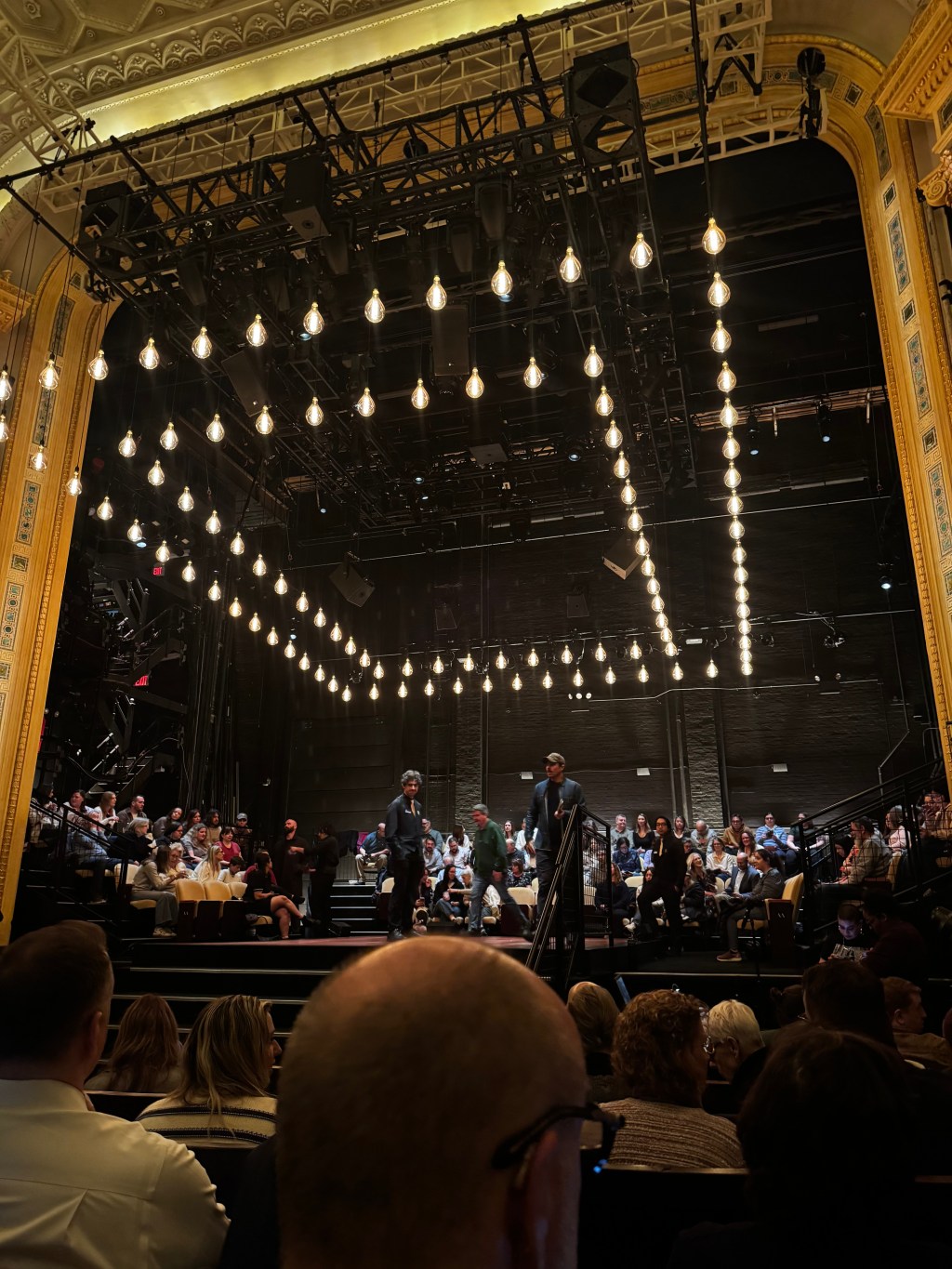
There is a particular kind of theatrical magic that does not announce itself with spectacle, but instead sneaks up on you, disarming, intimate, and ultimately overwhelming. Every Brilliant Thing is precisely that kind of experience. In its current New York run, it finds a near perfect steward in Daniel Radcliffe, whose performance is as unguarded as it is controlled, as playful as it is deeply felt.
This is not a play that hides its premise. A child begins a list, an ever growing catalog of things worth living for, in response to a mother’s depression. What unfolds is a lifetime told through fragments, audience participation, and the fragile persistence of hope. It is a structure that, in lesser hands, could feel precious or contrived. Here, it feels necessary.
Radcliffe’s greatest triumph is not that he commands the stage, though he does, but that he dissolves it. He collapses the distance between performer and audience with a generosity that never tips into indulgence. The house becomes a living organism. We are not observers. We are implicated. Co authors. Witnesses. At times, we are even the memory itself.
And yet, for all its interactivity, the performance never loses its emotional spine. Radcliffe understands something essential about this material. The humor is not decoration, it is survival. The laughs come easily, sometimes explosively, but they are always tethered to something deeper, something precarious. The play knows exactly when to pivot, when to let silence sit, when to land the blow.
It is, in many ways, a masterclass in tonal control.
Before the show, I found myself handed a line, Number 1007 on the list: “The fact that sometimes there is a perfect song to match how you are feeling.” It is a deceptively simple sentiment, almost throwaway in another context. But here, in the shared space Radcliffe so carefully builds, it lands with unexpected weight. The moment becomes less about the line itself and more about the act of offering it, of being momentarily folded into the narrative. It is theater not just as storytelling, but as participation in meaning making.
That is the quiet brilliance of Every Brilliant Thing. It understands that joy is not grand. It is cumulative. Specific. Often absurd. And sometimes, it is borrowed, from a stranger, from a memory, from a fleeting moment in a darkened room.
Radcliffe navigates the emotional terrain with remarkable precision. There is no vanity in the performance. He is willing to look awkward, to linger in discomfort, to trust the audience in ways that feel increasingly rare on stages of this caliber. And when the play reaches its more devastating turns, he does not oversell them. He allows them to arrive, to exist, to pass through.
The result is something profoundly affecting.
This is not theater that demands applause for its technical achievement, though its craftsmanship is undeniable. It is theater that earns something quieter and far more difficult, recognition. You see yourself in it. Or perhaps more accurately, you feel yourself seen.
In a city that often celebrates scale, Every Brilliant Thing reminds us of the radical power of smallness. A list. A voice. A room full of strangers, briefly connected.
And in the hands of Daniel Radcliffe, it becomes something close to essential.
 Brian Brijbag