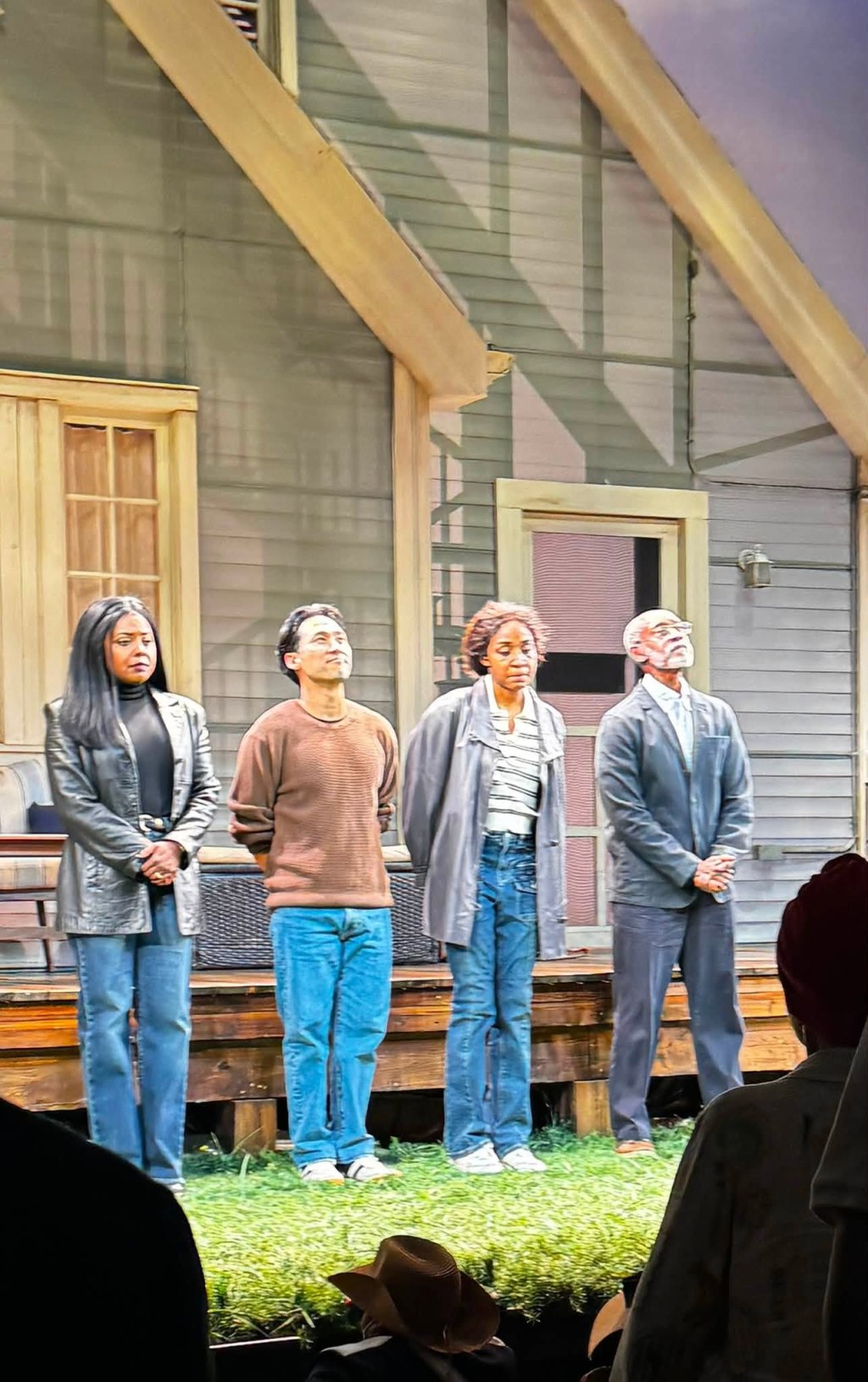
I saw Proof at the July 1 matinee, which feels like the correct way to see a play about genius, grief, and familial distrust: in the middle of the day, when the sun is behaving like an overconfident undergraduate and Broadway is full of people carrying tote bags, iced coffee, and unresolved maternal narratives.
David Auburn’s Proof has always been a tidy little bomb. It sits there, polite and prize-winning, with its cardigan of literary respectability, and then detonates in the one place theater still knows how to wound us: not in spectacle, not in revelation, but in the awful pause between saying “believe me” and realizing no one is going to.
The play’s premise is almost insultingly elegant. Catherine, 25, has spent years caring for her father Robert, a brilliant mathematician whose mind, once cathedral-like, became a haunted house. Now Robert is dead. His former student Hal is rummaging through notebooks. Catherine’s sister Claire arrives with the terrifying efficiency of a woman who has pre-labeled the emotional storage bins. A notebook is discovered. A proof – possibly historic, possibly impossible – sits inside it. The question is not only who wrote it, but who is allowed to be the sort of person who could have written it.
That last question remains the play’s sharpest instrument. Proof is often described as a drama about mathematics and mental illness, which is true in the way Hamlet is about succession planning. Its real subject is credibility: who gets it automatically, who must perform for it, who is denied it even when the evidence is sitting there in black ink.
At the Booth, Thomas Kail’s revival understands the play as a pressure chamber. It does not need to overdecorate the thing. The backyard, the house, the mathematical mythology: all of it exists as a domestic battlefield, a place where love has curdled into duty and intelligence has become both inheritance and accusation. The production’s restraint is mostly a virtue. Proof is not improved by theatrical jazz hands. It is a play that wants oxygen, silence, and actors brave enough to let discomfort sit at the table without offering it a beverage.
Ayo Edebiri’s Catherine is not a tragic waif with a genius problem. She is prickly, funny, evasive, exhausted, and allergic to being managed. Her performance has a restless interior weather. You can see Catherine thinking faster than the room will permit, and also fearing that thought itself may be a trapdoor. Edebiri is especially good when Catherine weaponizes sarcasm not as wit but as pest control. Everyone keeps coming toward her with concern, romance, plans, help. She swats them away because every offer contains a hidden verdict.
Don Cheadle’s Robert has an unnerving warmth: the charm of a man who was once the sun in every room and still expects light to behave accordingly. His scenes with Catherine have the peculiar tenderness of people who know each other too well to speak cleanly. Robert is both beloved and impossible; genius here is not romanticized so much as made inconvenient, domestic, and occasionally monstrous. The production lets him be funny, which is essential. Without humor, Robert becomes a diagnosis. With it, he becomes a father, which is much worse.
Jin Ha’s Hal has the awkward decency of a man trying very hard not to be one of the bad men in the story while still benefiting from the architecture they built. He is likable, and that likability is dangerous. Hal does not set out to diminish Catherine. He simply arrives already carrying the world’s assumptions in his pockets. The play’s genius is that betrayal need not be villainous to be devastating. Sometimes it is just polite, credentialed, and wearing a backpack.
Adrienne Warren, newly in the role of Claire, brings a crisp, fascinating charge. Claire can be played as a suburban corporate villainess in tasteful shoes, but Warren gives her something more slippery: love with a clipboard. She is not wrong to worry about Catherine. She is not right either. That is the awful little miracle of the part. Claire’s practicality is both care and colonization. She wants to save her sister, but her version of saving looks suspiciously like extraction.
What struck me most at the matinee was how cleanly Proof still exposes the gendered mechanics of doubt. Catherine does not merely have to prove authorship; she has to prove personality, sanity, plausibility, tone. She has to be brilliant but not erratic, wounded but not unstable, angry but not irrational, certain but not arrogant. In other words, she has to solve an equation with all the variables rigged.
The play’s most devastating move is that it understands belief as an emotional act pretending to be logical. Hal wants evidence. Claire wants stability. Catherine wants recognition. Everyone claims to be pursuing truth, but truth keeps getting mugged by fear, ego, attraction, family history, and the antique stupidity of “that doesn’t sound like something a young woman would do.”
There are moments when the revival’s polish threatens to become a cage. The play is so structurally perfect that a production can glide on its rails, and occasionally this one does. I found myself wanting, here and there, a little more danger, a little more mess, a sense that the floorboards beneath Catherine might not survive the afternoon. But perhaps that is also the point. Proof is not anarchic in form. It is anarchic in implication. It suggests that the civilized world – family, academia, romance, caretaking – may be held together by a series of elegant refusals to believe the person standing directly in front of us.
And then there is the math. Theater usually treats math as either decorative genius-confetti or social poison. Auburn does something better: he makes mathematics a language of longing. The proof in Proof matters less as a theorem than as a cry from a locked room. It says: I was here. I saw something. My mind made a bridge. Do not give the bridge to a dead man just because it is easier for you to admire him.
That, finally, is why Proof endures. It is not because the plot is clever, though it is. It is not because the Pulitzer and Tony seals still gleam on the label, though they do. It is because the play keeps finding new ways to ask an old, brutal question: What does a woman have to produce before the world stops calling her evidence circumstantial?
At the July 1 matinee, the audience laughed often, and then less often, and then not at all in the places where silence became the only sane response. That is the trajectory of a good play: it invites you in with wit, offers you a chair, and then removes the floor.
Proof remains a beautifully constructed argument against neat conclusions. Its arithmetic is emotional, its mystery moral. By the end, the question is no longer whether Catherine wrote the proof. The question is whether any of us are brave enough to accept what proof demands: not certainty, exactly, but the surrender of our favorite doubts.
 Brian Brijbag