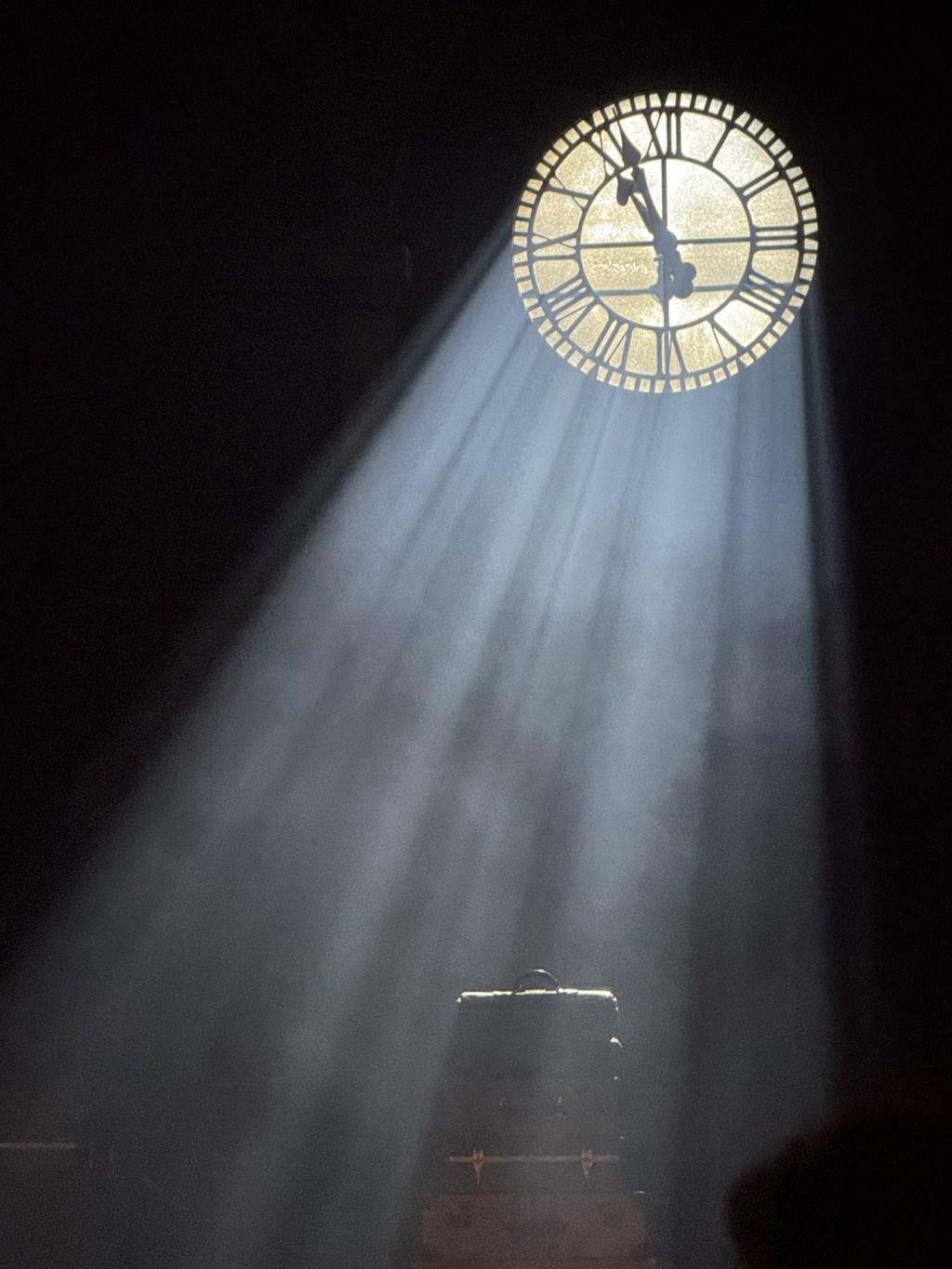
Harry Potter and the Cursed Child on Broadway is an undeniably impressive production from a technical standpoint, but as a complete theatrical experience, I found it much less satisfying than I expected. There is a great deal to admire in the staging, lighting, and special effects, yet those elements are doing most of the heavy lifting. Once the spectacle is stripped away, the story itself feels convoluted, surprisingly dull, and emotionally unconvincing.
The experience at the theater was efficient from the moment we arrived. The staff clearly knew how to manage a large and enthusiastic audience, and everything seemed organized and well controlled. They were somewhat strict about the rules, seating, phones, and general audience behavior, but I do not necessarily consider that a negative. A production this complicated depends on precise timing, and the theater is also trying to prevent distractions and preserve the surprises for future audiences. The staff’s approach could occasionally feel a little rigid, but they were professional, and the efficiency of the operation was appreciated.
The production’s greatest strength is unquestionably its visual design. The lighting is extraordinary. It does far more than simply illuminate the stage; it establishes mood, redirects attention, creates suspense, and makes the magical elements feel much larger than the physical space. There are moments when the entire theater seems to transform through light, shadow, movement, and carefully controlled darkness. Even when I was not engaged by the plot, I was often fascinated by how the production achieved a particular visual effect.
The special effects are equally impressive. Many of the magical moments are executed with remarkable precision, and several genuinely create the feeling that something impossible is happening in front of you. The production avoids relying entirely on screens or obvious digital tricks. Instead, much of the magic appears to come from inventive stagecraft, choreography, illusion, and timing. Those sequences are the clearest reason to see the show. There are transitions and reveals that are clever enough to make you temporarily forget your problems with the writing.
Unfortunately, the sound was much less consistent than the visual presentation. At various points, actors’ voices seemed to disappear into the space, and several lines were difficult or impossible to understand. Sometimes this appeared to be a problem with the sound mix, while at other times the actors may simply not have projected clearly enough. Either way, the result was frustrating. This is already a complicated story with a large amount of exposition, shifting relationships, and time-related plotting. Missing even a few lines makes the narrative harder to follow than it already is.
It was especially disappointing because a Broadway production of this size and reputation should not leave audience members struggling to hear important dialogue. The music and effects could occasionally overwhelm the voices, and some quieter exchanges became muddy. There were scenes in which I understood the general emotional direction but could not make out the specific words being spoken. That creates a distance between the audience and the characters, particularly during moments that are supposed to carry emotional weight.
The cast is clearly working hard, and the physical demands of the production must be considerable. The actors have to navigate rapid transitions, complicated blocking, technical effects, and a story that shifts tone frequently. There are energetic performances and some effective comic or dramatic moments. However, the performances are limited by the material. Several characters feel more like devices for moving the plot forward than fully developed people, and the dialogue often has to explain so much that it leaves little room for subtlety.
My main problem was the story. It is extremely convoluted without being especially interesting. Complexity can be rewarding when it deepens the themes or reveals something unexpected about the characters. Here, the complications often feel mechanical. The plot keeps adding twists, revisions, consequences, and explanations, but very little of it made me more invested in what was happening. Instead of becoming more suspenseful, it became increasingly exhausting.
The show asks the audience to keep track of a great deal of information, yet the emotional core remains surprisingly thin. There are potentially interesting ideas about parents and children, expectations, regret, friendship, and the burden of a famous family name. However, those ideas are repeatedly buried beneath the machinery of the plot. The story seems more interested in rearranging familiar pieces of the Harry Potter universe than in developing a compelling new narrative.
There is also a persistent sense that the production is depending on the audience’s affection for the original books and characters. Familiar names, places, references, and situations are used to generate recognition, but recognition is not the same thing as emotional impact. At times, the show feels less like a necessary continuation of the story and more like an elaborate exercise in revisiting the past. Fans may enjoy seeing pieces of the Harry Potter world brought to life onstage, but the script does not always give those moments enough purpose beyond nostalgia.
The pacing contributes to the problem. Despite the amount of activity onstage, portions of the show feel slow. There is a difference between a production being busy and a story being engaging. The Cursed Child is almost constantly in motion, yet I often felt detached from the characters and impatient for the next major visual sequence. That is not a good sign for a drama that wants its relationships to matter as much as its magic.
The emotional scenes also tend to be overstated. Characters explain their feelings repeatedly, and conflicts are often presented in broad, obvious terms. There are moments that should be moving, particularly those involving difficult family relationships, but the writing pushes so insistently for emotion that the effect can become artificial. Instead of feeling absorbed in the characters’ pain, I was frequently aware that the play was trying very hard to produce a reaction.
That said, the production deserves real credit for its theatrical ambition. It is rare to see stage magic executed on this scale, and the technical team has created a visually memorable experience. The lighting, movement, effects, costumes, and scene changes are coordinated with tremendous skill. Even the moments that do not work dramatically are often impressive as feats of live production. There is genuine pleasure in watching a theater use practical ingenuity to create a world that feels unstable, mysterious, and magical.
Ultimately, however, technical brilliance cannot completely compensate for an uninteresting story and inconsistent sound. I left admiring the craft more than the play. The show contains several astonishing images and effects that I will remember, but I was not emotionally invested in the characters, and I did not find the plot rewarding enough to justify how complicated it became.
For devoted Harry Potter fans, the production may still be worth seeing for the spectacle and the experience of returning to that world in a live setting. The effects and lighting alone are far beyond what most stage productions attempt. But anyone hoping for a strong, clear, emotionally compelling story may come away disappointed. Harry Potter and the Cursed Child is a remarkable technical achievement wrapped around a weak and unnecessarily tangled narrative. The magic is impressive; the drama is not.
 Brian Brijbag