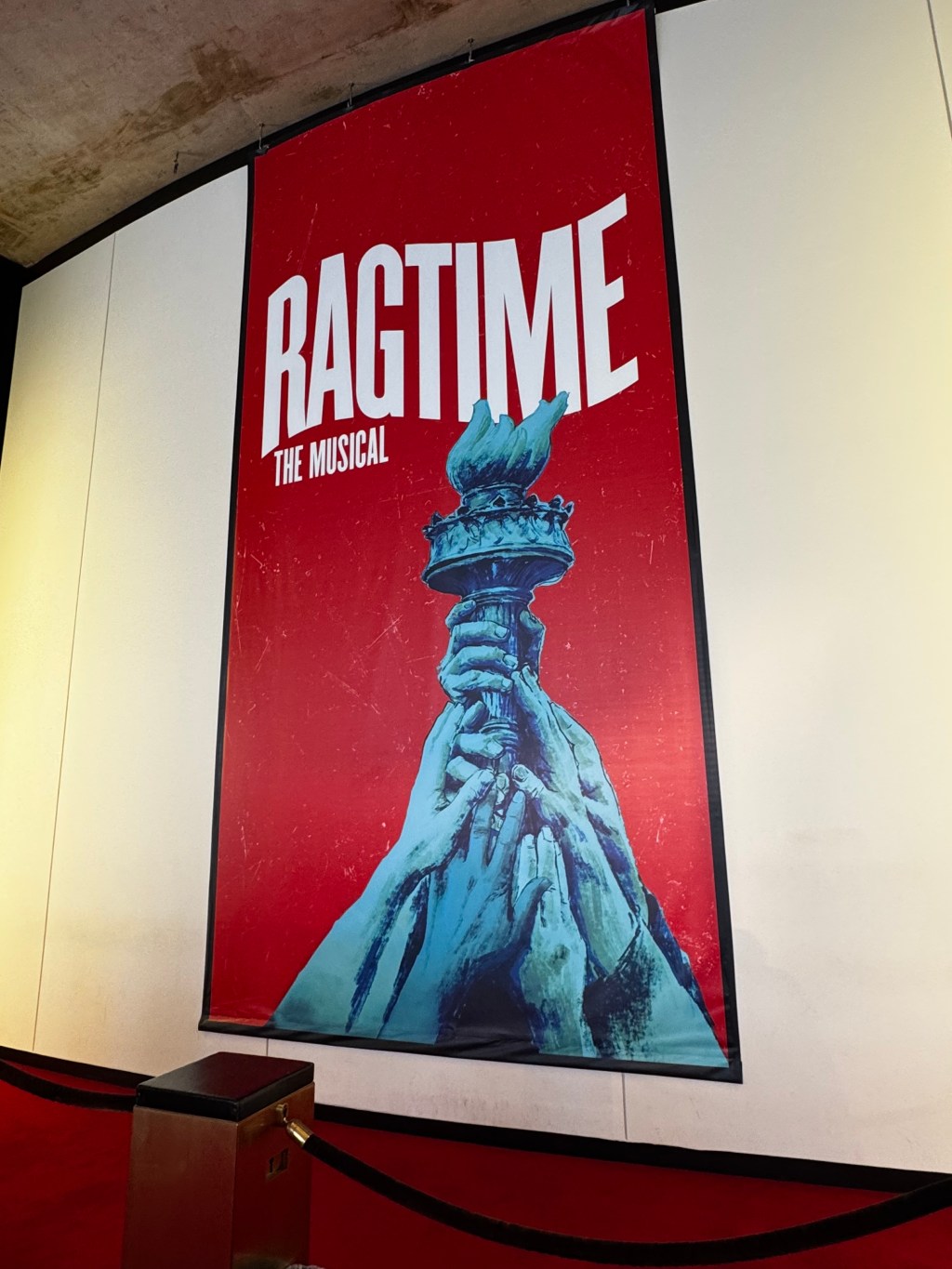
There are musicals that tell a story about America.
There are musicals that celebrate America.
And then there is Ragtime, which asks America to sit down, be quiet, and listen to the stories it has spent more than a century trying not to hear.
I saw Lincoln Center Theater’s revival of Ragtime on July 29, and I absolutely loved it. Not simply admired it. Not merely appreciated its importance. I loved it in that overwhelming, deeply theatrical way where the music enters your chest, the performances dismantle your defenses, and you leave the theater feeling both devastated and strangely renewed.
With a book by Terrence McNally, music by Stephen Flaherty, lyrics by Lynn Ahrens, and a story drawn from E.L. Doctorow’s novel, Ragtime interweaves the lives of a prosperous white family, a Black musician and the woman he loves, and a Jewish immigrant struggling to build a future for his daughter. Lear deBessonet directs this revival with remarkable clarity, allowing an enormous American epic to remain profoundly human.
From the opening number, the production feels like a country assembling itself before our eyes. Different communities enter with their own rhythms, assumptions, fears, and dreams. They begin separated, arranged into neat categories, but history refuses to let them remain that way. Their lives collide, overlap, and permanently alter one another.
The staging is visually impressive without burying the story beneath spectacle. David Korins’s largely open design, combined with moving architectural pieces, staircases, projections, lighting, and the enormous depth of the Vivian Beaumont stage, gives the production scale while keeping the actors at its center. It feels spare without ever feeling small. The stage becomes a train station, a suburban home, a Harlem street, a factory, a baseball field, and eventually a battleground over who is entitled to dignity in America.
Joshua Henry gives a monumental performance as Coalhouse Walker Jr., but what makes it so powerful is that he never begins by playing Coalhouse as a monument. He begins as a man. A confident, joyful, talented man who is in love, who has purchased a beautiful car, and who believes that decency will be met with decency.
That belief is systematically destroyed.
Henry allows us to watch every stage of that destruction. His Coalhouse does not suddenly become angry because the plot requires it. We see humiliation harden into resolve, resolve become desperation, and desperation transform into something both morally complicated and completely understandable. By the time he sings “Make Them Hear You,” the song is no longer simply a great Broadway anthem. It becomes an accusation, a prayer, and a command.
Nichelle Lewis is heartbreaking as Sarah. Her performance contains an extraordinary combination of vulnerability, strength, fear, and hope. When she and Henry sing “Wheels of a Dream,” the song feels suspended outside time. For a few minutes, the future they imagine appears not only possible, but inevitable. That is what makes everything that follows so painful.
Caissie Levy gives Mother one of the evening’s most complete and satisfying transformations. She begins inside a life that has already been arranged for her, surrounded by comfort but denied genuine agency. Levy never forces Mother’s awakening. She allows it to accumulate through experience, compassion, disappointment, and finally clarity.
“Back to Before” is magnificent because Levy does not perform it as a conventional declaration of empowerment. She sings it as someone realizing that the person she has become can no longer fit inside the life she once accepted. It is not triumphant because change is easy. It is triumphant because returning to ignorance has become impossible.
Brandon Uranowitz brings humor, tenderness, exhaustion, and fierce paternal love to Tateh. His journey represents another version of the American Dream, one built through imagination, reinvention, and an almost unreasonable refusal to surrender hope. Uranowitz makes Tateh specific rather than symbolic. We see the frightened father, the frustrated worker, the artist, the survivor, and eventually the man who discovers that creating a new life may require creating an entirely new version of himself.
The entire company is exceptional. The ensemble does not merely decorate the principal characters’ stories. It creates the social forces surrounding them. It becomes privilege, prejudice, poverty, celebrity, industry, resistance, and community. The voices are enormous, the orchestra is glorious, and the score remains one of the most beautiful and emotionally intelligent ever written for the American musical theater.
What makes this revival feel so urgent is that it does not treat the early twentieth century as safely completed history. Its subjects are painfully recognizable: racism disguised as maintaining order, immigrants described as a threat, wealth mistaken for virtue, celebrity offered as distraction, and justice distributed according to status and skin color.
The production has not substantially rewritten the original text to manufacture that relevance. The world around the musical has changed how we hear it. That may be the most unsettling thing about the evening. Ragtime does not feel prophetic because it predicted our future. It feels prophetic because we have failed to travel nearly as far from its past as we would like to believe.
At nearly three hours, Ragtime is unapologetically large. It contains history, politics, romance, tragedy, vaudeville, immigration, labor unrest, racial violence, family upheaval, and even a few famous people wandering through the machinery. Yet its size is part of its argument. America cannot be explained through one family, one community, one triumph, or one tragedy.
By the final moments, the production offers hope, but it is not cheap hope. It does not suggest that progress is automatic or that history naturally bends toward justice while the rest of us remain comfortably seated. Its hope comes from people choosing to see one another, protect one another, and carry forward the dreams of those who were denied the opportunity to realize them.
I left Lincoln Center emotionally wrecked, exhilarated, and incredibly grateful.
This Ragtime is not simply a beautiful revival of a great musical. It is a reminder of what musical theater can accomplish when music, history, performance, and moral urgency all move in the same rhythm.
It is sweeping without losing intimacy, political without becoming a lecture, heartbreaking without surrendering to despair, and hopeful without lying to us.
One of the finest productions I have seen.
Absolutely extraordinary.

