writing
-

Metallica. Wu-Tang. Theme parks. Senators. Parents. Clients. Verdicts. All in six days. Still think your week was busy? In seven days, I went from the front row of concerts to the front lines of advocacy – answering calls from injured clients between bass drops, senate strategy sessions, and coasters that defy physics and patience. I…
-

Building Narrative Weight from Seemingly Mundane Objects There is a particular kind of arrogance that arises during early drafts, where we playwrights believe our themes will be obvious because we’ve written them in capital letters and made two characters argue about Nietzsche in the rain. They won’t be. What audiences remember – what they feel –…
-

Dramatic Archetypes in the Legal World – and How to Counter Them Litigation, for all its procedural decorum, is theatre. There’s a script (your pleadings), a stage (the courtroom), a captive audience (jury or judge), and, most importantly, characters. Now, some attorneys enter the courtroom like extras in a background deposition scene – unmemorable, beige,…
-

by Brian S. Brijbag, Esq. Every night, they came in droves – leathered, liquored, spiritually limber. Stadiums shook with the seismic sincerity of 80,000 people pretending they weren’t pretending. But in Section A, Row 12, upstage left of the main screen, just above the fourth subwoofer, there lived a pixel. A single, glowing, tremoring green pixel. It…
-
(Or, why your unmarketable dream project written at 2 a.m. in a hoodie stained with Pad Thai might just be your magnum opus) Let’s begin with a premise no marketing team wants to hear: the idea that makes your friends tilt their heads and say “…Huh” might be the thing that actually works. I’m not…
-

By Brian S. Brijbag, Esq. There’s something magical — and maddening — about the one-act play. Too short to waste time.Too long to just be a scene.Too finite to wander.Too powerful to be dismissed. A great one-act doesn’t feel like a short play. It feels like a complete world — one that opens, cracks, burns, and closes in…
-

By Brian S. Brijbag, Esq. In one of my plays, a married couple is trapped in their Florida kitchen during a hurricane. Power’s flickering. A stranger named “Florida Man” has barged in. And sitting on the counter – unassuming, innocent, shimmering with citrus significance – is the last slice of key lime pie. It’s just a…
-
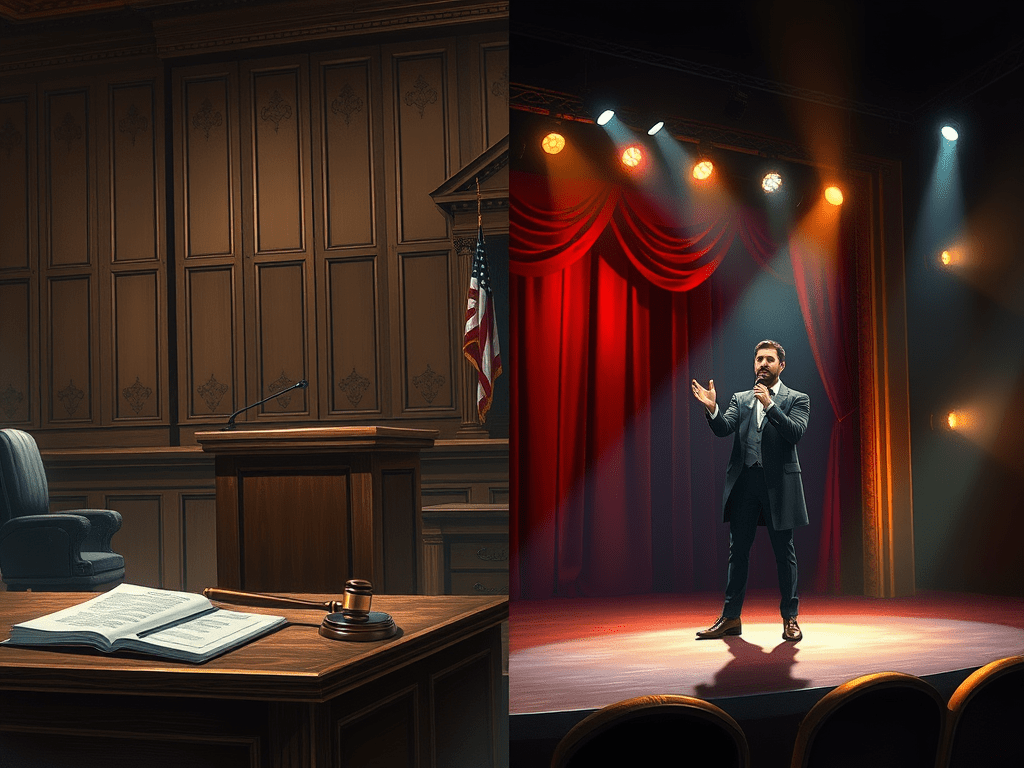
By Brian S. Brijbag, Esq. I’ve stood in courtrooms, neck deep in depositions, cross-examinations, and medical exhibits — building arguments on logic, precedent, and pain. And I’ve also stood on stage in a community theater, wearing eyeliner and shouting about cursed pies and funeral rehearsals for divine absences. This used to confuse people.Honestly, it used…
-

By Brian S. Brijbag, Esq. There’s a special kind of theatre that doesn’t just entertain — it unhinges your expectations, flips them inside out, and then serves them back to you with a sly wink and a perfectly timed blackout. When people ask what kind of plays I write, I sometimes fumble.“Absurdist.”“Dark comedy.”“Meta-theatrical, structurally chaotic, character-driven……
-

By Brian S. Brijbag, Esq. There are regions that shape stories.And then there’s Florida, which doesn’t just shape them — it inhales them, spins them around, wraps them in alligator skin, and sets them loose on I-75 wearing flip-flops and holding a Publix sub. Florida isn’t just a setting.Florida is a genre.And once you write theatre here,…
 Brian Brijbag