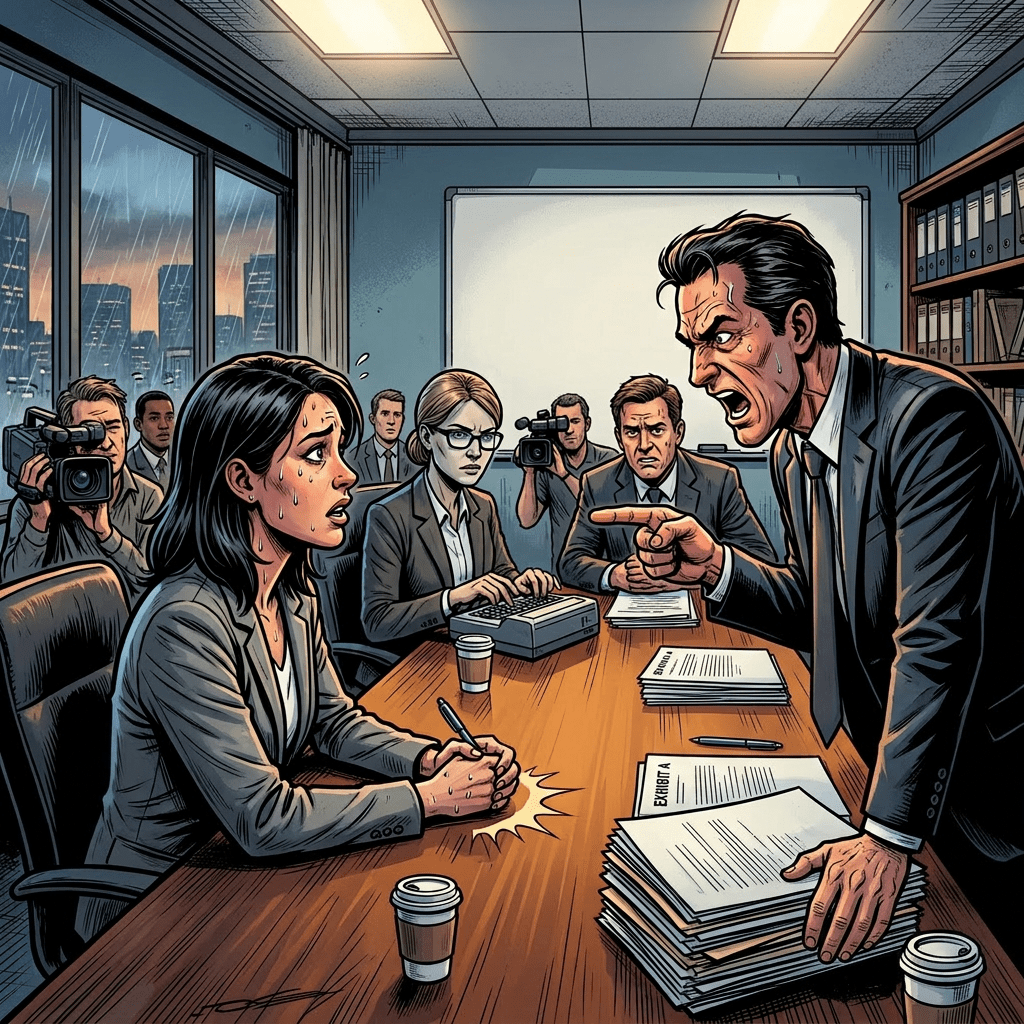
There is a conference room in every mid-sized law office in America with bad carpet, worse coffee, and a court reporter who has seen things. I have spent a meaningful percentage of my adult life in rooms like this, and I am here to tell you that it is the finest playwriting education money can buy, except you get paid to attend, which is more than I can say for my MFA-holding friends.
A deposition, for the uninitiated, is a legal proceeding in which one lawyer asks a witness questions under oath while another lawyer objects to the form of those questions, and everyone pretends this is normal. It can last seven hours. Nothing happens. It is the most dramatic thing I have ever seen.
Let me explain.
Boredom Is a Pressure Cooker
New playwrights are terrified of boredom. They pack every scene with incident because they think the audience will leave if nothing explodes. The deposition teaches you the opposite lesson: tedium is not the absence of drama, it is the container for it.
Hour one of a deposition is name, address, employment history. Hour two is documents. By hour three, the witness has forgotten they are performing. Their shoulders drop. They start answering the question that was actually asked instead of the question they prepared for. And that is when the case cracks open, in a flat voice, over a question about a calendar entry, while everyone in the room is thinking about lunch.
Chekhov knew this. Beckett built a career on it. The audience does not need constant stimulation. The audience needs to be lulled, just slightly, so that the moment of rupture lands like a slap in a quiet room. If your play is all rupture, you have written a car alarm.
Nobody Says What They Mean, Under Oath or Otherwise
Here is a thing that happens in depositions: a lawyer asks, “Did you read the contract before you signed it?” and the witness says, “I’m a very busy person.”
That is not an answer. That is a confession wearing a sweater.
Playwrights agonize over subtext as if it were a spice you sprinkle on dialogue after the fact. But subtext is not decoration. Subtext is what people do instead of answering. Real humans, even under penalty of perjury, even with a court reporter taking down every syllable, will do almost anything to avoid saying the true thing directly. They answer adjacent questions. They define terms. They suddenly remember nothing about the one meeting that matters and everything about the eleven that don’t.
If your characters answer each other’s questions cleanly, you have not written people. You have written a customer service script. Go sit in a deposition and watch a grown adult spend four minutes not saying the word “yes.”
People Lie Badly, and That Is the Good Part
Television has ruined lying. On TV, liars are smooth. They maintain eye contact. They have rehearsed.
In real life, under oath, people lie the way toddlers hide: feet sticking out from under the curtains, fully convinced they are invisible. They over-explain. They volunteer details no one asked for. They get suddenly, suspiciously precise about everything except the thing in question. The bad lie has a shape, and the shape is more interesting than the truth, because the shape tells you what the liar is afraid of.
That fear is character. When you write a character who lies, do not write the lie. Write the architecture around the lie, the fortifications, the strange detours, the unprompted alibi for a Tuesday no one mentioned. The audience should be able to draw a chalk outline around the thing your character refuses to say.
The Objection Is an Interruption With a Law Degree
Stage dialogue dies when characters take turns. Real conversation is a contact sport, and the deposition formalizes this beautifully: one lawyer is trying to build a rhythm, and the other lawyer’s entire job is to break it. “Objection, form.” “Objection, asked and answered.” “Objection, are we really doing this.”
Watch what the interruption does. It does not just stop the sentence. It changes who is winning. The witness gets a breath. The questioning lawyer loses the thread or pretends not to. Power in a room moves through interruption, and the deposition makes that movement visible, timed, and transcribed.
Your scenes should work the same way. Track who interrupts whom and you will find your power map. If the same character is interrupting on page 5 and page 50, nothing has happened in your play, no matter how many things have happened in your plot.
There Is Always an Audience, Even When There Isn’t
The court reporter does not react. That is the job. Seven hours of confessions, evasions, and one memorable incident involving a man crying about a boat, and the court reporter’s face remains a Swiss bank.
But everyone in the room performs for her anyway. The witness checks her face after the bad answer. The lawyers modulate for the record, that great invisible audience of appellate judges who may someday read every word. People cannot help shaping themselves for the watcher, even a watcher who has been professionally trained to give them nothing.
This is the whole secret of theatre. Your characters are always performing for someone: the other character, the absent parent, the version of themselves they are hoping to become. Find out who each character’s court reporter is. Then make them say something they can never take off the record.
The Assignment
So here it is. Call a lawyer friend. Every playwright has one; we are drawn to you because you have feelings and we have billable hours. Ask to observe a deposition. Bring a notebook and the willingness to be bored for three hours.
Somewhere around hour four, a person under oath will tell a small, badly constructed lie about something that does not matter, and the entire room will pretend not to notice, and you will understand more about dramatic writing than any craft book has ever taught you.
Objection noted. Overruled. Keep writing.

