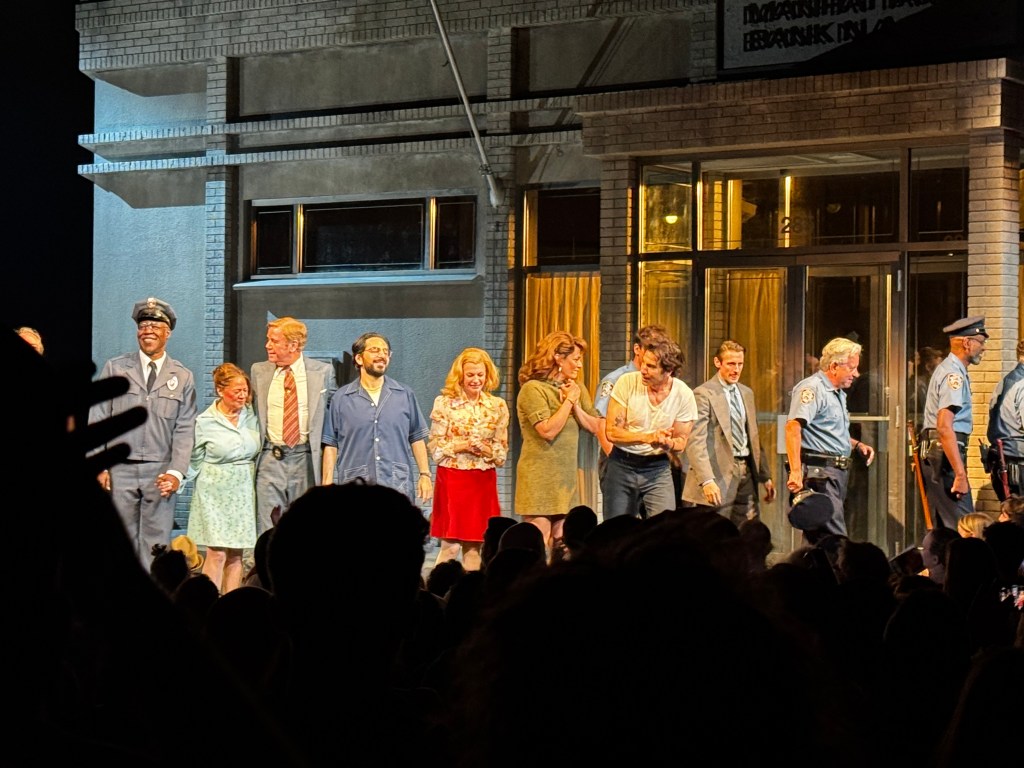
On June 13, 2026, I had the opportunity to see Dog Day Afternoon on Broadway, and it delivered one of the most enjoyable afternoons of theatre I have experienced in quite some time.
Like many theatergoers, I came into the production with a deep appreciation for the iconic 1975 film. Adapting a beloved movie for the stage is always a challenge. Audiences arrive with expectations, comparisons are inevitable, and there is a temptation to simply recreate what worked before. Thankfully, this production avoids that trap. Instead, it embraces the strengths of live theatre and creates an experience that feels immediate, intimate, and uniquely its own.
What surprised me most was how funny it was.
The story itself is built around a bank robbery that spirals out of control, a premise that does not immediately suggest comedy. Yet the production finds humor in the absurdity of human behavior, in the interactions between characters, and in the sheer chaos of a situation that becomes increasingly impossible to manage. The audience laughed often, and those laughs never undercut the tension. In fact, they heightened it. The humor made the characters feel real, which made the stakes feel even higher when events took darker turns.
The cast was exceptional across the board, but Jon Bernthal was particularly outstanding. His performance carried a raw energy that was impossible to ignore. Every moment felt grounded, authentic, and unpredictable. He brought a humanity to the role that kept the audience invested from beginning to end. There are actors who command attention simply by entering a scene. Bernthal is one of them. Even in moments of silence, he was telling a story.
Ebon Moss-Bachrach was equally impressive. His work was nuanced, layered, and deeply engaging. The chemistry among the cast members helped create a world that felt lived in rather than performed. No one seemed to be chasing individual moments. Instead, everyone was working together to serve the story, which is often the hallmark of a great ensemble.
One of the unsung stars of the evening was the set design.
The physical production was stunning. The set managed to feel both realistic and theatrical at the same time. It captured the environment of the story while also allowing for fluid storytelling. What impressed me most were the transitions between scenes. They were executed with remarkable precision and creativity. Rather than feeling like interruptions, the transitions became part of the storytelling itself. The production maintained momentum throughout the evening, and the movement from one scene to the next felt seamless.
As a playwright, I am always paying attention to how a production solves practical storytelling problems. This production solved them beautifully. The design team clearly understood that every element of the stage picture should support the narrative. Nothing felt excessive. Nothing felt distracting. Every choice seemed purposeful.
The pacing was excellent. The tension steadily increased as the evening progressed, creating a sense of mounting pressure that kept the audience engaged. Even though many people know the outcome of the story, the production managed to make every development feel immediate and uncertain.
What I appreciated most was the humanity at the center of it all.
It would have been easy to present these characters as larger-than-life figures or historical curiosities. Instead, the production focuses on people. Flawed people. Desperate people. Funny people. Complicated people. That choice allows the audience to connect with the story on a deeper level.
After the performance, I spent some time at the stage door and had the opportunity to meet many members of the cast. Every interaction was warm, gracious, and genuine. One of the things I love most about theatre is that connection between artists and audiences. Unlike film, theatre remains profoundly personal. The performers had just completed an emotionally demanding performance, yet they were generous with their time and appreciative of the people who had come to support the show.
Those moments only enhanced my appreciation for what I had just witnessed.
Great theatre is not simply about what happens under the lights. It is about the community that forms around the experience. It is about artists and audiences sharing a moment that can never be replicated in exactly the same way again.
Dog Day Afternoon succeeds because it understands that truth. It is tense. It is funny. It is smart. It is beautifully staged. Most importantly, it is deeply human.
Broadway productions often arrive with considerable hype. Some meet expectations. Some fall short. This one exceeded mine.
If you have the opportunity to see Dog Day Afternoon, take it. You will find yourself laughing more than you expect, gripping your armrest during moments of tension, admiring the ingenuity of the production, and appreciating a cast operating at an exceptionally high level.
For me, it was a reminder of why I fell in love with theatre in the first place.

